Co-Op Tower Defense Strategy: Roles, Spending, and Lanes
Split building, spending, and lane coverage in co-op tower defense. Use role checklists, handoff calls, and leak diagnosis to coordinate your next run.
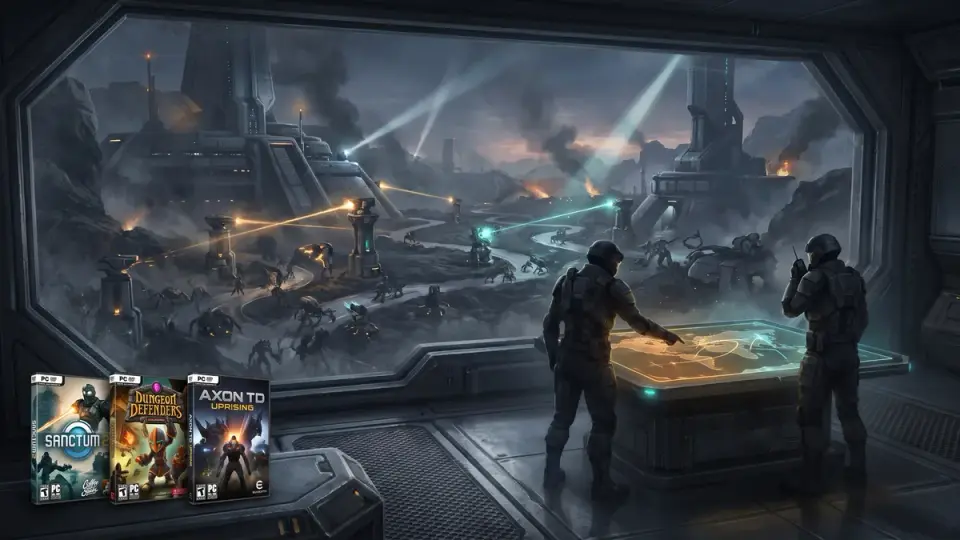
Your next leak may need a clearer handoff, not another tower. Good Co-op tower defense strategy rests on five agreements made before the first wave. Every approach gets an owner and a backup, and one player is named build coordinator. The team names the next funded fix, and nobody starts the wave until everyone confirms they are ready. Any player who leaves an approach also gets an acknowledgment from the player taking it over.
The protocol is built for friends starting Co-op defense together, especially groups where one player has far more hours than the others. It keeps the strongest player from becoming everyone's manager and gives newer players responsibilities with clear edges. Sanctum 2, the original Dungeon Defenders, and Axon TD: Uprising each show a different coordination problem.
Quick take
- The protocol: owner and backup per approach, one build coordinator, one named next expense, a readiness check, and acknowledged handoffs. It works in any Co-op defense game once the group has checked the mode's rules.
- Sanctum 2: practice for separating the tower plan from where each player fights. It suits groups who like aiming and shooting.
- Dungeon Defenders: practice for splitting hero combat duty from building proposals. It suits groups who want an action RPG layer.
- Axon TD: Uprising: practice for announcing route edits before they happen. It is less plug-and-play than the other two, because every maze change forces a fresh coverage check.
Co-op tower defense roles: the agreement before wave one
Assign responsibilities to approaches first, then to jobs. An approach owner watches one entry route for the whole wave and calls threats on it. The backup is the named player who takes over that route when the owner must leave. The build coordinator collects proposals and states the team's next purchase out loud, without controlling everyone's clicks.
A pair combines these roles. Player one owns the left approach and backs up the right, player two does the reverse, and one of them also coordinates builds for the match. Rotating the coordinator role each match keeps the more experienced player from deciding everything.
Larger groups should separate the roles, within whatever group size the mode supports. A third player can coordinate builds full time, and a fourth can track resources and confirm who can actually pay for each proposal. Fewer players end up doing two jobs at once in the middle of a wave.
Responsibility is not the same as mechanical ownership. Agreeing that Jo coordinates builds does not mean Jo can place, upgrade, sell, or fund a tower in that mode. The game decides who can act on a decision, so the plan has to follow the rules the group confirms next.
Check the rules before dividing the work
Run this table in the lobby. Answers marked "Confirm" are things your group checks on its own platform, game version, and mode before assigning anyone a building or funding job.
| Check | Sanctum 2 | Dungeon Defenders | Axon TD: Uprising |
|---|---|---|---|
| Developer | Coffee Stain Studios | Trendy Entertainment | Element Studios |
| Co-op | Listed | Listed | Listed |
| Platform, version, mode | Confirm | Confirm original game | Roguelite runs listed; confirm Co-op mode |
| Group size | Confirm | Confirm | Confirm |
| Resource ownership | Confirm | Confirm | Confirm |
| Transfers | Confirm | Confirm | Confirm |
| Place, upgrade, sell | Confirm | Confirm | Confirm |
| Readiness control | Confirm | Confirm | Confirm |
Four answers shape everything that follows. Whether money is pooled or personal decides how you budget. Whether balances transfer decides who can fund a fix. Whether teammates can modify each other's towers decides who executes a plan. Whether the game has a ready-up control decides how you confirm the team is set before a wave starts.
Write the answers down in a chat message or note. A rule the whole team agreed on in the lobby settles arguments faster than a rule each player half-remembers.
Separate the tower plan from combat coverage in Sanctum 2
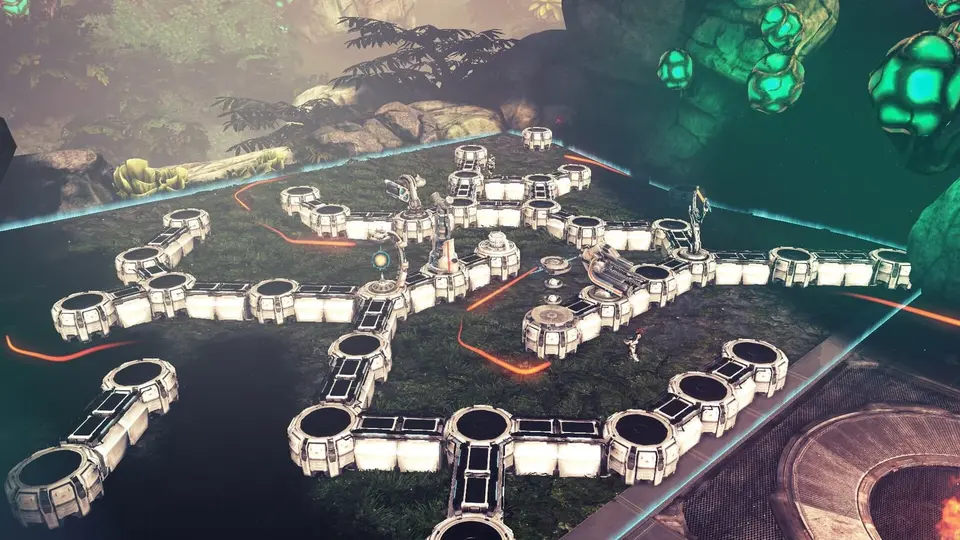
TowerWard's catalog describes Sanctum 2 as: First-person shooter tower defense with co-op and tower placement in 3D space.. That combination creates a specific Co-op trap. Players who shoot enemies themselves drift toward the loudest fight, and the towers they placed stop being anyone's responsibility.
Treat the tower plan and combat coverage as two separate agreements. The tower plan covers where towers go and which approach each group of towers protects. Combat coverage covers where each player stands and shoots during the wave. Placement in 3D space raises the stakes, because a tower position that looks covered from one player's view can leave gaps another player sees clearly.
Here is an example agreement for a pair, using placeholder names. Alex owns the left approach in combat and backs up the right. Jo owns the right approach in combat, backs up the left, and proposes the tower plan for both sides. Towers get placed by whoever the mode allows to place them, after Jo states the plan and Alex agrees.
That agreement says nothing about weapons or loadouts. It only fixes who watches which route and who proposes construction, which is the part that stops two shooters from abandoning the same approach.
Coordinate hero and building duties in the original Dungeon Defenders
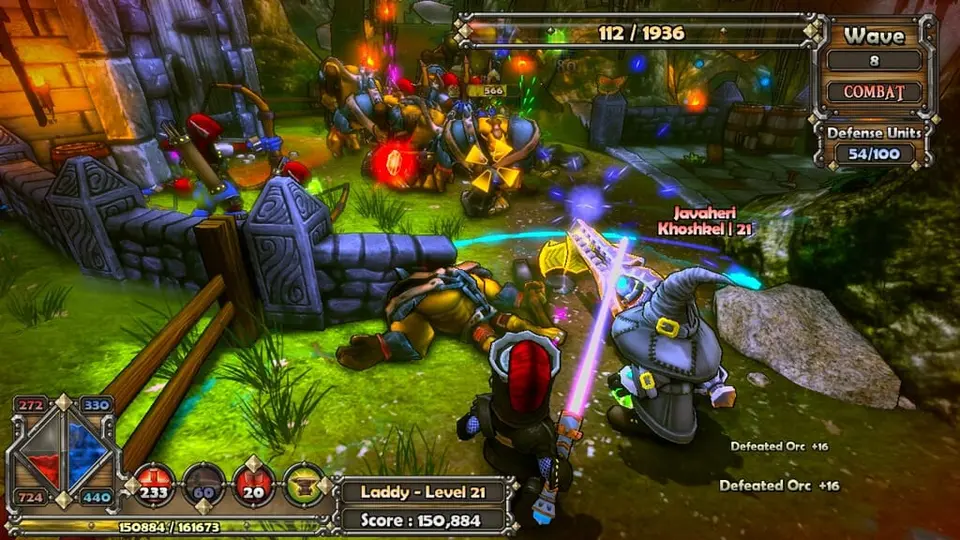
This section covers the original Dungeon Defenders, not Dungeon Defenders 2. TowerWard's catalog describes it as: Action RPG meets tower defense with co-op, heroes, and tower building in dungeons.. The hero layer gives every player two jobs at once: fighting as a character and contributing to the tower layout.
Split the duties by asking three questions in order. First, who covers which approach with their hero during the wave? Second, who proposes the next tower or modification? Third, who is permitted to build, upgrade, or sell it under the rules your group confirmed in the lobby? The third answer can change the second. A proposal from a player who cannot build that defense becomes a request to the teammate who can.
Make each request specific. "Can you put a defense covering the north stairs before the timer ends?" gives a newer player a bounded task with a location and a deadline. "Help with defenses" gives them nothing to act on and pushes the experienced player back into managing everyone.
Funding follows the same logic. If the lobby check shows that each player pays from their own resources, the build coordinator's plan has to name who pays, not just what gets built.
Announce route changes in Axon TD: Uprising
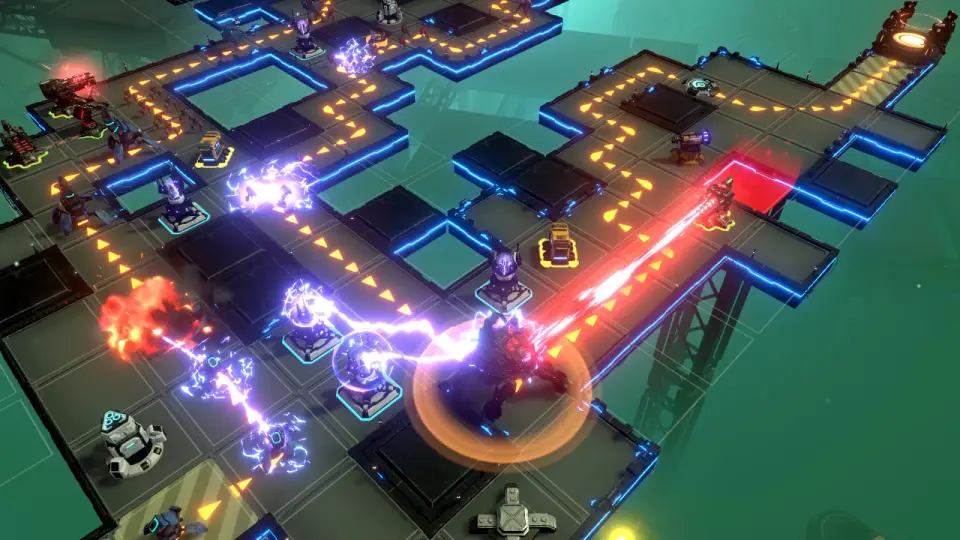
TowerWard's catalog describes Axon TD: Uprising as: Modern tower defense with expandable map boundaries, mazing, co-op, and roguelite runs.. Mazing means towers shape the path enemies walk, and expandable map boundaries mean the area you defend can grow. Either change can move enemies away from coverage a teammate thought was settled.
That is why route edits need their own routine. On a fixed path, a new tower adds firepower to a lane everyone already watches. In a maze, a new tower can reroute the whole wave. The difference between fixed paths versus mazing is the reason every route edit requires a fresh coverage check.
Use a three-step routine:
- Propose. "I want to block the gap by the center. Enemies will route past the south side instead."
- Confirm. Every owner of an approach the new path touches says "confirmed" or raises a problem. Teammates whose routes are untouched do not need to respond.
- Recheck. Before the wave starts, each affected owner looks at the new path and states whether their towers still reach it.
Expanding the map follows the same steps, with one addition: new ground needs an owner and a backup before the wave that uses it begins. Roguelite runs are the listed mode, so run this routine in whichever mode your lobby check confirmed supports Co-op.
Tower defense resource allocation: fund the next likely failure
Spend on the threat most likely to break the defense next, not on equal shares or each player's favorite upgrade. How you do that depends on how your mode handles money.
- Shared pool. The build coordinator ranks the proposals and the team spends top-down. Anyone permitted to build can execute, so the only question is what comes first.
- Transferable personal balances. Rank the proposals the same way, then move money to the player who can build at the threatened spot. Confirm transfers before the wave timer runs low.
- Nontransferable personal balances. Rank the proposals, then check which player can afford and place each one. The team total is a planning number, not a spendable one.
Worked example: a fictional 600-credit wave
This example uses a fictional shared-pool ruleset, separate from the three games above. All values are assumptions. The team has 600 credits. The east approach has no defense and needs a 300-credit tower. The west approach leaked last wave and needs a 200-credit fix. A teammate also wants a 200-credit optional upgrade.
The two coverage problems come first, because each one can lose the wave and the upgrade cannot. The coordinator funds both: 300 + 200 = 500 credits spent. That leaves 600 − 500 = 100 credits. The optional upgrade costs 200, more than the remaining 100, so it waits.
The deferral is the decision that matters. The upgrade has a reason and a place in the queue, and the player who proposed it hears that it is next once income allows. Naming it as the next expense keeps the request alive without starving an uncovered approach.
Now change one rule: balances are personal and nontransferable. Assume Player A holds 450 credits and Player B holds 150. The total is still 600, but B cannot afford either fix. A can pay for the 300 tower or the 200 fix, but not both, since 300 + 200 = 500 is more than 450. The team covers the empty east approach first, with A paying, and the west fix waits until someone earns enough. Total team wealth said both fixes were affordable. The ownership rule says only one can happen this wave.
Tower defense lane coverage: handoffs, then leak diagnosis
An approach is only covered if someone is watching it. When two players both leave their routes to chase the same emergency, the original problem gets solved and a new one opens behind them. A handoff fixes this by making one defender accountable at every moment.
The handoff script
A complete handoff names the threatened approach, the incoming threat, the receiving player, an acknowledgment, and a return condition:
- Leaving player: "East approach has incoming enemies; Sam, can you cover while I help west?"
- Sam: "Covering east."
- Leaving player: "I'm back on east when west is clear or the next wave starts, whichever comes first."
- Sam: "Got it. Calling you back if east gets heavy."
The rule is strict and simple: no acknowledgment, no departure. If Sam is busy and does not answer, the leaving player stays and calls the west problem to someone else. Setting the backup this way is part of how a team should plan for a defensive failure before it happens.
The post-wave diagnosis
After a leak, name three things before anyone suggests a fix: the route enemies used, what those enemies did, and where coverage was missing. Then sort the cause into one category.
| Cause | Question to ask |
|---|---|
| Placement | Did towers reach the path enemies took? |
| Spending | Was the needed fix funded, or deferred too long? |
| Execution | Was the plan right but carried out late? |
| Communication | Did a handoff, request, or route change go unconfirmed? |
Here is an example. Enemies leaked through east late in the wave. Sam had acknowledged the handoff but left east to finish a purchase, and the original defender had not come back yet. The towers reached the path, so placement was fine. The cause was communication: the return condition did not cover what Sam should do in the meantime.
Choose one adjustment and say what you will watch. In this case, the backup stays on east until the original defender says "back on east." Next wave, the team watches the east approach during handoffs and checks whether it holds. One change at a time tells you whether that change worked. A leak points to a gap in the plan, not to a bad teammate.
Copy this next-wave checklist
Hold the line with the same six checks before every wave:
- Rules confirmed: platform, version, mode, group size, resource ownership, transfers, build permissions, and readiness control.
- Owners and backups named: every approach, including any new ground, has both.
- Build changes announced: route edits and tower changes proposed, confirmed by affected owners, and rechecked.
- Next funded fix named: with the player who will pay for it and place it.
- Handoffs acknowledged: no one leaves an approach without a "covering" reply and a return condition.
- One adjustment agreed: taken from last wave's diagnosis, with the approach you will watch.
Start your first coordinated session with the pair template: each player owns one approach and backs up the other, and the less experienced player takes the build coordinator role for the first match. Groups that like shooting should practice in Sanctum 2, groups that want heroes should practice in the original Dungeon Defenders, and groups ready for route-editing pressure should practice in Axon TD: Uprising. If your group has not settled on a game yet, first choose a co-op tower defense game, then bring this checklist to the lobby.
Games In This Article

Written by Roy Levy
Writer and editor at TowerWard
Roy Levy is a full-stack developer and strategy-game enthusiast who writes and edits TowerWard content focused on tower defense, base defense, and defense strategy games. He's especially interested in wave design, economy depth, and the small choices that make one TD or base-defense game click for a certain kind of player.