GemCraft: Chasing Shadows vs GemCraft: Frostborn Wrath: Which Should You Play First?
Chasing Shadows teaches gem jobs with nine colors. Frostborn Wrath is the later, harsher chapter with fewer gems, new buildings, and larger fields. Here is which to play first.
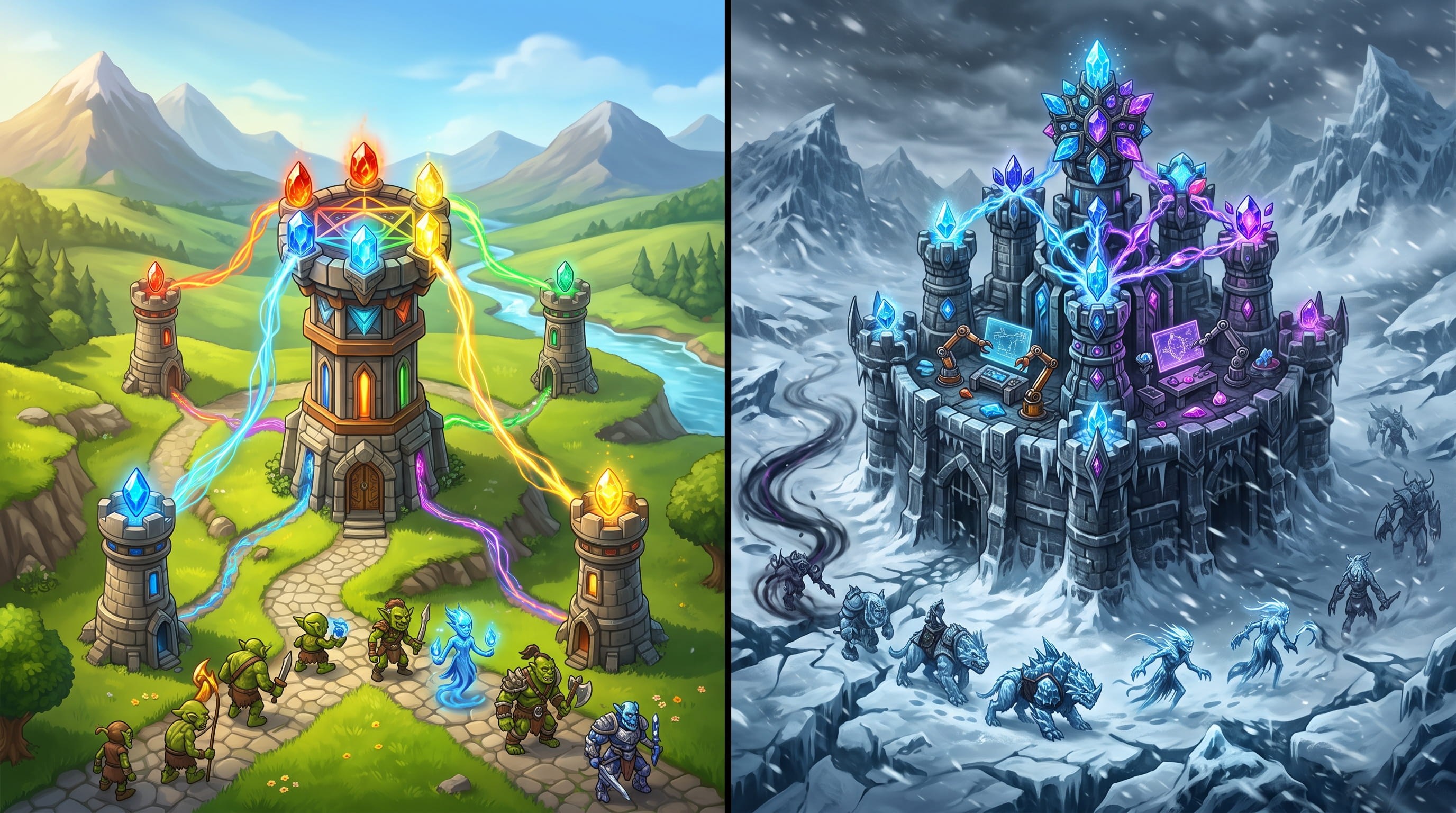
GemCraft: Chasing Shadows vs GemCraft: Frostborn Wrath is not a quality contest. Both are Game in a Bottle’s gem-combining tower defense: you craft colors, socket them into buildings, spend mana, and hold long wave pressure.
The real split is chapter design. Chasing Shadows (2015) makes each gem color a job. Frostborn Wrath (2020) bakes the old scaling colors into every gem, cuts the roster to six, then asks more of the map: larger fields, lanterns, pylons, linked waves, and harsher trials.
Play Chasing Shadows first if you want to learn why a dual-color gem in the right socket beats a late damage gem. Play Frostborn Wrath first only if you already want the later, heavier chapter.
Quick verdict
| If you want... | Start with... |
|---|---|
| To learn gem combining as a language | Chasing Shadows |
| Nine specialized gem colors, including Chain Hit and Suppression | Chasing Shadows |
| Smaller, more readable fields | Chasing Shadows |
| The newer HD chapter with better quality-of-life | Frostborn Wrath |
| Lanterns, pylons, linked waves, and larger maps | Frostborn Wrath |
| The harsher endurance and trial laboratory | Frostborn Wrath |
Both games punish chasing listed damage. The useful test is whether enemies stay in a kill zone long enough for mana income to fund the next upgrade.
At a glance
| Category | Chasing Shadows | Frostborn Wrath |
|---|---|---|
| Released | 2015 (Chapter 2) | 2020 (Chapter 5) |
| Gem colors | Nine specializations | Six; Poolbound and Bloodbound bonuses on every gem |
| Signature colors | Chain Hit, Suppression, Poolbound, Bloodbound | Bleeding; Chain Hit and Suppression are gone |
| New buildings | Towers, traps, amplifiers, walls, shrines | Adds lanterns and pylons |
| Fields | 54×32 tiles | 60×38 tiles, larger pixels, native HD |
| Challenge modes | Vision fields | Trial mode on almost every field |
| Extra pressure | Battle traits, endurance | Traits, endurance stones, linked waves, enrage gem slot |
| Best first purchase | Most new wizards | Players who want the current, harder chapter |
Gem combining: nine jobs versus six streamlined colors
This is the difference that actually changes how you think.
GemCraft: Chasing Shadows gives you nine components: Mana Leech, Critical Hit, Poolbound, Chain Hit, Poison, Suppression, Bloodbound, Slow, and Armor Tearing. Poolbound scales with your mana pool. Bloodbound scales with hits. Those are choices. Putting white or black in a gem is a build decision, not a free stat.
That is why Chasing Shadows is the cleaner teacher. You can see what a color is for. A cheap dual-color gem that starts leeching or tearing armor in the right socket often beats a high-grade damage gem that arrives too late. You learn to separate raw damage from useful damage, and a strong tower from a stable kill zone.
GemCraft: Frostborn Wrath keeps Mana Leech, Critical Hit, Poison, Slow, and Armor Tearing, then adds Bleeding. Poolbound and Bloodbound no longer exist as colors. Every gem gets those scaling bonuses automatically. Chain Hit and Suppression are removed.
That is not “more gem engineering.” It is narrower color identity and stronger baseline scaling. Combinations still matter, especially Bleeding with Critical Hit, but you are no longer deciding whether a gem should be the poolbound or bloodbound specialist. The game moved that complexity into buildings, field size, and traits instead.
If the fantasy is “I want more distinct gem recipes,” Chasing Shadows has the wider kit. If the fantasy is “I want every gem to scale while I solve a harder field,” Frostborn Wrath is the later ruleset.
Maps, buildings, and why Frostborn Wrath feels heavier
Placement is part of the build in both games. A good gem in a late or poorly aimed socket is worse than a cheaper combination that starts controlling the lane.
Chasing Shadows is the better classroom for that lesson because the fields are smaller and the building list is the classic set: towers, traps, amplifiers, walls, shrines. You can ask simple geometric questions. Where do enemies stay long enough to matter? Which socket pays for itself? How much of the map can one cluster cover?
Frostborn Wrath keeps that logic and adds hardware. Lanterns hit several targets at once with reduced gem power. Pylons let a gem fire into a support structure instead of acting like a normal tower. Fields are larger. Waves can be linked, so giants and swarmlings arrive together. There is an enrage gem slot that juiced every wave if you socket it.
That is why Frostborn Wrath is not automatically the better game. It is the chapter that asks you to place a bigger kit on a bigger board under tighter timing. Map-specific solutions matter more. A general-purpose gem spread that felt fine in Chasing Shadows can fall apart when two waves share a spawn and your lanterns are in the wrong pocket.
Difficulty, trials, and endurance
Both games are long-form defense. Early success is cheap. The run is whether mana, armor tearing, and placement still work when waves keep escalating.
Chasing Shadows sequences the learning. Skills and some gem types come from tome chambers, so the system opens in stages. Vision fields are the locked-down skill checks. Endurance exists, but the campaign is a more readable on-ramp into “plan past the current wave.”
Frostborn Wrath is built for players who already like failed experiments. Trial mode on almost every field fixes gems, spells, and mana regardless of wizard level, similar to vision fields but much more common. Endurance starts at wave 1 and extends with endurance wave stones. Battle traits stack into nasty replay modifiers. Linked waves and the larger board make a leak harder to locally patch.
Start with Frostborn Wrath only if that sounds like the point. If you are still learning why a dual-color gem belongs in one socket instead of another, the extra field rules feel like noise.
A practical warning that applies to both: do not buy the highest listed damage first. Timing funds the kill zone. The kill zone funds mana. Mana funds the expensive gem. Reverse that order and the number on the gem never gets to matter.
Quality of life and which version feels current
Frostborn Wrath is the game that is easier to operate. One-click gem creation, pre-set creation grade, mouse-wheel upgrades in inventory, native HD, and a redesigned interface are real improvements over Chasing Shadows. It also has the talisman fragment system for persistent bonuses.
That is the honest case for skipping ahead. If you bounce off older interfaces, Frostborn Wrath will feel like the one that respects your time. You still have to learn gem combining. You just do it with fewer colors and more field pressure.
Chasing Shadows looks and handles like the earlier chapter it is. The trade is the gem roster and a gentler map size while you build instincts.
Neither has co-op. Both are single-player wizard campaigns with trait grinding and achievement hunting. Frostborn Wrath has the larger achievement list and the more modern presentation.
Play Chasing Shadows first if you want...
- A first language for gem combining
- Nine colors with real jobs, including Chain Hit and Suppression
- Smaller fields where placement mistakes are easier to read
- Tome-gated skills that open the system in stages
- Endurance defense without lanterns, pylons, and linked waves on day one
This is the recommendation for most players, including veterans who have never played GemCraft. The game is still deep. It is simply the chapter that teaches the series instead of examining you on it.
Skip it only if you already know you want the 2020 ruleset and do not care about the missing colors.
Play Frostborn Wrath first if you want...
- The current HD chapter with faster gem handling
- Lanterns, pylons, larger fields, and linked waves
- Trials, trait stacking, and endurance stones as the main loop
- Bleeding gems and universal pool/hit scaling instead of those as dedicated colors
- A harder laboratory once the gem basics already make sense
This is the concentrated recommendation, not the default. Frostborn Wrath is the better later GemCraft. It is the better first GemCraft only for players who specifically want that friction.
Final recommendation
For most players, play GemCraft: Chasing Shadows first. It has the wider gem identity and the clearer path into mana, placement, and kill-zone thinking.
Choose GemCraft: Frostborn Wrath first only if you want the later chapter on purpose: fewer gem jobs, more buildings, bigger fields, and a trial/endurance loop that keeps resisting you after you understand the basics.
The first game teaches you how a GemCraft defense works. The second asks whether that defense still holds when the field gets larger and the waves arrive together.
FAQ
Which GemCraft should a new player buy?
Chasing Shadows. You learn what each color is for before the later chapter adds lanterns, pylons, and linked waves.
Is Frostborn Wrath just a harder Chasing Shadows?
No. It is a later chapter with a different gem roster. Poolbound and Bloodbound became universal bonuses. Chain Hit and Suppression were removed. Bleeding, lanterns, pylons, larger maps, and common trial mode are new.
Which game has more gem build variety?
Chasing Shadows, if you mean distinct color jobs. Frostborn Wrath has fewer colors but more ways to socket them (lanterns and pylons) and harsher field constraints.
Does Frostborn Wrath replace Chasing Shadows?
No. Plenty of players still prefer Chasing Shadows for Chain Hit, Suppression, and specialized pool/blood gems. Frostborn Wrath replaces it only if you want the newer presentation and the heavier maps.
Which game is better for endurance mode?
Frostborn Wrath if you want a dedicated endurance loop with wave stones and constant trials. Chasing Shadows still has long runs; it is just less built around that laboratory from the start.