Which Kingdom Rush Game Should You Play First?
Pick your first Kingdom Rush game by tower choice, hero involvement, campaign pressure, and platform-specific purchases across five catalog entries.
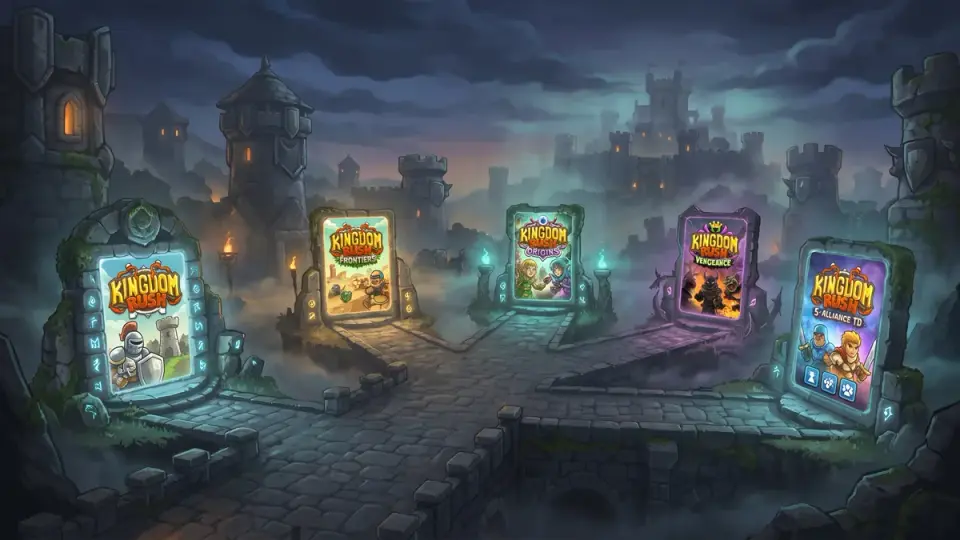
The best Kingdom Rush starting point is the one that gives you the defensive decisions you want to make. The strongest entries in this series do more than line a road with towers. They make you choose which tower branch to commit to, where your hero stands when a wave breaks, and when to call the next wave early for extra gold.
If you are asking which Kingdom Rush game to play first, the answer is Kingdom Rush. It is the cleanest Classic Tower Defense entry in the series and the most Beginner-Friendly of the five. Start elsewhere only for a specific reason: a different setting, a new tower roster, a villain campaign, or a two-hero campaign.
Quick take: the best Kingdom Rush game to start with
- Kingdom Rush: the safest first pick. It suits anyone new to the series who wants the core loop taught at a fair pace.
- Kingdom Rush Frontiers: the next step up. It suits players who already know fixed-path tower defense and want new towers and heroes from the first stage.
- Kingdom Rush Origins: the setting pick. It suits players drawn to elves and mages who want the classic structure in a different skin.
- Kingdom Rush Vengeance: a more specific taste. It suits players who want to command the villain's side and plan which towers to bring into each stage.
- Kingdom Rush 5: Alliance TD: the two-hero pick. It suits players who want the newest roster and are ready to command two heroes at once and choose their towers before each stage. It is the busiest first game here.
Kingdom Rush games comparison: the five-game starting matrix
Two axes matter more than anything else, and they should be judged separately. Tower decisions cover what you build, where you build it, and which upgrade branch you lock in. Hero involvement covers how often you need to move your hero and how much your defense depends on it.
| Game | Tower decisions | Hero load | First campaign | Buy check |
|---|---|---|---|---|
| Kingdom Rush | Four families, branch at top tier | One hero, optional micro | Gentle ramp | Heroes per store |
| Kingdom Rush Frontiers | New branches on familiar families | New heroes to learn | Expects the basics | Heroes per store |
| Kingdom Rush Origins | Elven roster, druid artillery | One hero, elven roster | Familiar ramp | Heroes per store |
| Kingdom Rush Vengeance | Pick a loadout per stage | Villain heroes | Loadout choices early | Towers and heroes |
| Kingdom Rush 5: Alliance TD | Pick five towers per stage | Two heroes at once | Loadout and heroes early | Towers and heroes on mobile |
Use the matrix in a fixed order. Platform and an acceptable purchase structure decide which games are eligible at all. Your preferred tower decisions and hero load then decide fit, and campaign demands and setting break any tie. A game you cannot get on your device, or whose add-on structure you dislike, drops out before quality comes into it.
Kingdom Rush: the Beginner-Friendly default
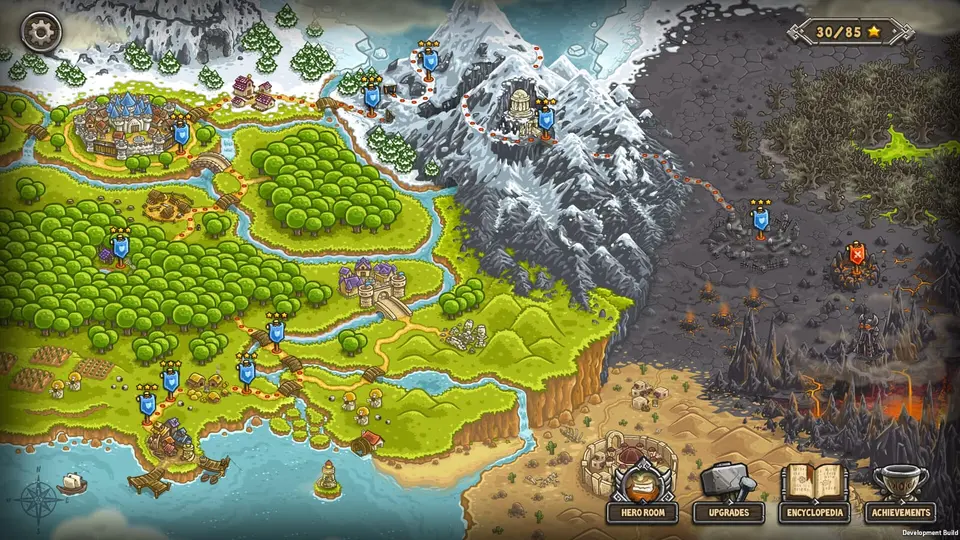
Classic fantasy tower defense with tight maps, hero abilities, and satisfying difficulty curves. All three parts of that pitch help a first-timer. Tight maps keep the number of roads small enough to read at a glance. A clear difficulty curve means early stages teach one idea at a time instead of testing everything at once.
The tower system is the series template. There are four families: Archer, Barracks, Mage, and Artillery. Each upgrades through ordinary levels before splitting into two specialized towers at the top tier, such as the Rangers Hideout or the Musketeer Garrison for archers. That branch is your first real commitment, and it teaches you to build for the enemies a stage actually sends rather than for raw damage.
Barracks are what make Kingdom Rush feel distinct. Their soldiers physically block the road, and you set their rally point. A good chokepoint pairs one Barracks holding enemies in place with Mage or Artillery fire landing on the crowd. That killbox shape transfers to every later entry, and the fixed-path tower placement basics apply directly to it.
Hero involvement is light by design. You can park your hero at a chokepoint and leave it there, or move it to plug a leaking lane, but most stages do not demand constant micro. The two spells, Rain of Fire and Call Reinforcements, run on cooldowns. Calling the next wave early pays bonus gold and shortens those cooldowns, so defensive timing becomes a skill you pick up naturally.
The main campaign is the part a newcomer needs, and it can be played on a gentler difficulty setting. Heroic and Iron challenges unlock per stage afterward and restrict your tools while cutting your margin for leaks. Those modes are for completionists and Hardcore players; skipping them does not weaken a first run.
Kingdom Rush does not suit someone who already knows the series' four-family structure and wants a newer roster immediately. For that player, the gentle opening can feel slow. Developed by Ironhide Game Studio, it remains the reference point the other four entries build on, and the Kingdom Rush game profile gathers its details in one place. If you are still deciding whether this style of lane defense suits you at all, the Kingdom Rush vs Bloons TD 6 comparison sets the two approaches side by side.
Kingdom Rush Frontiers: start here for new towers and heroes
Second Kingdom Rush with new heroes, towers, and a tropical campaign. The four tower families return, but their top-tier branches are new. The Necromancer raises skeletons from fallen enemies, and the DWAARP hits everything near it with area damage. Your choice of branch now changes how a lane plays, not just how fast it clears.
The reason to start here instead of the original is freshness. If you have played other fixed-path games and know what a Barracks blocking point does, Frontiers skips the slow introduction and asks you to build around stranger enemies and a wider set of heroes.
The tradeoff is that Frontiers expects the basics. Its stages assume you understand branch commitments and rally points, so a complete newcomer gets less hand-holding. It is not the right first game for someone who has never placed a tower.
Kingdom Rush Origins: the elven prequel with a refined roster
Prequel to Kingdom Rush with elves, mages, and refined TD mechanics. The four-family structure stays, rebuilt around elves. Archers, Barracks, and Mages take elven forms, and the Artillery slot becomes the Druid Henge, which hurls boulders rather than firing cannons. The placement decisions match the original's, with towers that look and behave differently.
Choose Origins first when the setting is what pulls you in. Its learning demands sit close to the original's because the systems are refined rather than replaced. A newcomer who wants elves and magic gives up very little by starting here, and the curve still teaches lane coverage and early-wave timing.
The tradeoff is small but real. Origins builds its refinements on players knowing the original's template, so its very first stages explain a little less than Kingdom Rush does.
Kingdom Rush Vengeance: play the villain and plan your loadout
Play as the villain in the Kingdom Rush series with new towers and sci-fi flair. This is where tower decisions change most. Before each stage you choose which towers to bring from your unlocked roster, so planning starts before the first enemy appears. A wrong loadout can leave a lane uncovered no matter how well you place what you brought.
Choose Vengeance first if commanding the dark side is the draw, or if you like settling your strategy before a stage starts. Its loadout system rewards players who read a map in advance and pick tools for its chokepoints.
The tradeoff is a heavier first impression. A newcomer has to learn tower roles and loadout planning together, which makes Vengeance less forgiving than the original as a first game. It also has the most purchase variation to check, because the towers and heroes included in the base game can differ by storefront.
Kingdom Rush 5: Alliance TD: the two-hero starting case
Kingdom Rush 5: Alliance TD is a single-player campaign, released in July 2024. The alliance in the title is a story one: the warriors of Linirea and the Dark Army fight side by side against a new threat. There is no PvP or co-op mode.
Two changes matter for a first game. You take two heroes into every stage, so hero load doubles: two units to position and two sets of abilities to time. And as in Vengeance, you choose which towers to bring, five per stage, from a larger roster, so planning starts before the first wave.
Choose Alliance first if you want the newest towers and heroes and enjoy managing several moving parts at once. The two-hero format is the main reason to start here rather than with the original.
The tradeoff is load. A newcomer learns tower roles, loadout planning, and two-hero positioning together, which makes Alliance less forgiving than the original as a first game. If you were looking for Kingdom Rush against other players, that is a separate game: Kingdom Rush Battles, a free-to-play PvP release for mobile.
Kingdom Rush playing order: release, story, and your own
These are three separate orders, and only the third should decide your first install.
- Release order: Kingdom Rush, Kingdom Rush Frontiers, Kingdom Rush Origins, Kingdom Rush Vengeance, Kingdom Rush 5: Alliance TD. This is the order in which the systems were built up, which is why the original reads as the template.
- Story chronology: Origins comes before Kingdom Rush because it is the prequel, and Frontiers follows the original. Vengeance tells the conflict from the villain's side and works as its own campaign.
- Preference order: start with the game that matches your platform, purchase comfort, tower and hero preferences, and setting. Every other game is optional.
The campaigns stand on their own as tower defense. You do not need the prequel's story to enjoy the original, and you do not need the original to understand the prequel. Story position and starting suitability are separate questions, and treating the series as a checklist only delays the first install.
Make the choice
Here is the method applied to one reader. As an example, take a reader who already owns Kingdom Rush and Kingdom Rush Origins, wants an elven and mage setting, and has no preference about story chronology.
- Eligibility. Both games are installed, so the additional base-game cost is 0 for each. Both pass, and neither has an advantage.
- Tower and hero fit. Both use the four-family structure with top-tier branches and a single controllable hero. The fit is a tie.
- Tie-breaker. The stated setting preference is elves and mages, which matches Origins. With no chronology preference, the prequel position neither adds nor subtracts anything.
Result: this reader installs Kingdom Rush Origins first. Preference moved the first game away from the default. Remove the setting preference, and campaign demands break the tie instead: the original's gentler ramp makes Kingdom Rush the pick.
Before you buy, check the edition on your own storefront:
- The listing matches the device you will play on, since Mobile and PC versions can be packaged differently.
- Which heroes are included and which are sold separately.
- For Vengeance, which towers and heroes come with the base game.
- For Alliance TD on mobile, which heroes and towers are sold separately.
Choose your frontline: Kingdom Rush is the first game for most newcomers. Frontiers is the next step up for players who already know fixed-path defense. Origins, Vengeance, and Alliance TD earn the first slot only when a setting, a villain campaign with loadout planning, or a two-hero campaign gives you a concrete reason. One finished campaign is a complete decision. If you enjoy it, the natural next game is the one whose matrix row looked most interesting, with no obligation to play the rest.
If none of these five fit how you want to defend, beginner-friendly tower defense picks cover easy entry points into tower defense outside the series.
Games In This Article

Written by Roy Levy
Writer and editor at TowerWard
Roy Levy is a full-stack developer and strategy-game enthusiast who writes and edits TowerWard content focused on tower defense, base defense, and defense strategy games. He's especially interested in wave design, economy depth, and the small choices that make one TD or base-defense game click for a certain kind of player.