Best Tower Defense Games for Beginners
Find a beginner-friendly tower defense game with readable lanes, meaningful placement, instructive failure, and enough wave pressure to build real skill.
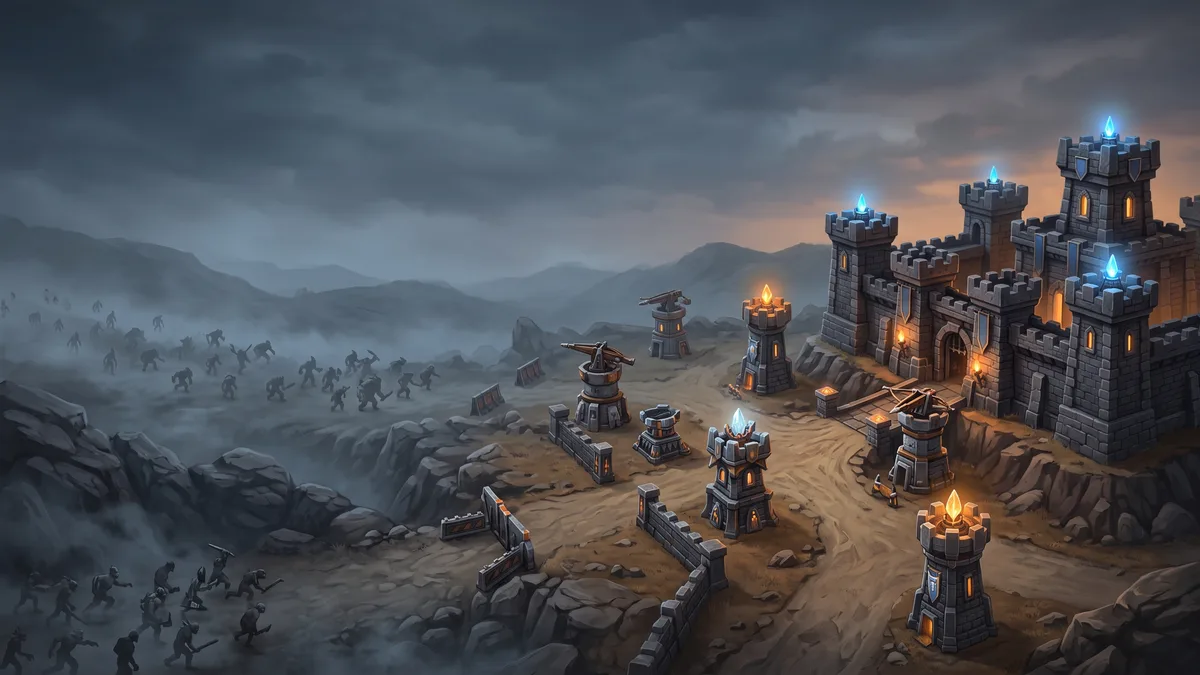
The best first tower-defense game teaches you why a lane leaked instead of quietly letting any layout win. Beginner-Friendly should mean readable systems and instructive failure, not negligible difficulty or automated progress.
What a worthwhile beginner game must teach
A strong introduction keeps consequences but makes them understandable. When an enemy escapes, you should be able to trace the failure to an uncovered lane, a range boundary, poor target priority, or resources committed at the wrong time.
Four qualities matter most:
- Readable positioning: Tower ranges, routes, and chokepoints make it clear why one placement holds and another leaks.
- Consequential resource timing: An economy upgrade can strengthen later defenses, but buying it before securing the current lane creates an immediate, understandable risk.
- Instructive counters: Enemy traits and defensive responses are communicated clearly enough that trial and error builds transferable skill.
- Recoverable mistakes: An inefficient early placement costs resources or lives without forcing an unexplained restart.
That rules out idle defense games, clickers, autobattlers, and layouts that succeed regardless of coverage. They may be accessible, but they skip the spatial and economic decisions that define wave defense.
Choose the defensive model you want to learn
Lane-based defense is usually the clearest starting point. Fixed routes make leaks easy to diagnose: a tower lacked coverage, an intersection went unused, or resources went into the wrong lane. Pick this if you want the tightest feedback loop between placement and failure.
Open-placement defense hands you control over engagement geometry. It suits players who would rather experiment with range, pathing, and chokepoints than solve fixed routes, but only when those boundaries are clearly shown. Without that feedback, freedom becomes guesswork.
Base-building shifts attention to fortification, production, and protecting infrastructure. It fits newcomers who prefer planning a perimeter over positioning individual towers, provided the game makes clear how resource commitments affect immediate survival.
Survival emphasizes endurance under mounting pressure. It works as a first step only when escalation is readable and failure shows what overwhelmed the defense, so it suits players comfortable learning through repeated losses.
Hybrid Tower Defense layers tower placement with another substantial system, such as direct unit control or broader base management. It is the right entry for newcomers who actively want more responsibility; skip it if extra systems would bury the defensive decisions you are trying to learn.
Treat platform as a separate decision
Controls, pause-and-plan support, and offline play can differ between versions of the same game. A layout that is easy to read with a mouse can become imprecise on a small touchscreen, so weigh how you will actually play alongside the defensive model.
Choose your frontline by the failure you want to understand: fixed-lane coverage, open chokepoint control, fortification planning, escalating survival, or hybrid responsibility. If you are unsure, start lane-based; it makes every leak the easiest to explain.