Mindustry vs The Riftbreaker: Which Fits You?
Compare Mindustry and The Riftbreaker by supply logistics, combat, defensive preparation, and recovery to choose the base-building game that fits you.
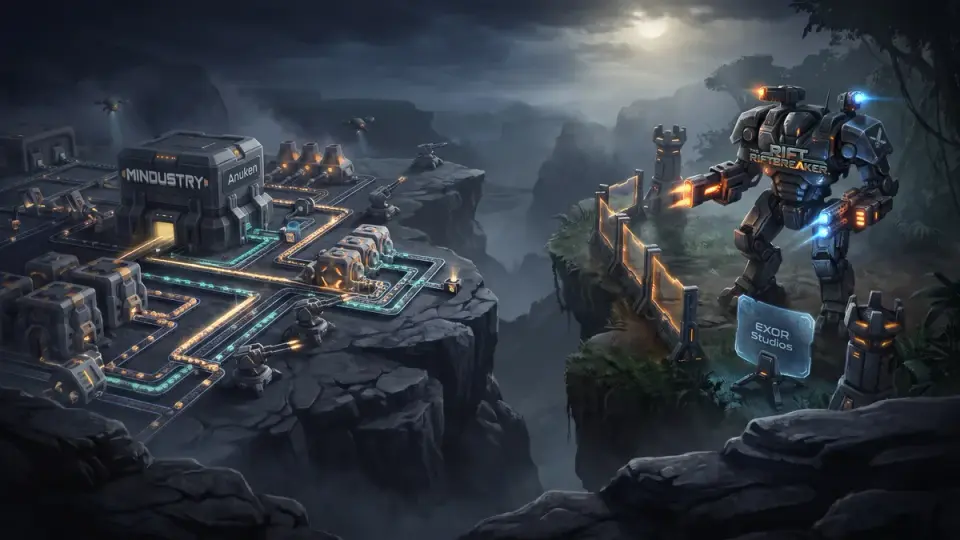
Would you rather fix the supply problem behind your defenses or join the fight in front of them? The best base building tower defense games keep giving you a job after the first base is up, and Mindustry and The Riftbreaker hand you different jobs. Mindustry is the stronger fit if conveyor logistics are part of the appeal. The Riftbreaker is the stronger fit if you want direct combat to share the spotlight with your base.
Both are sci-fi base builders that make you defend what you build. The real difference is what you are doing in hour twenty, not which game has the longer feature list. Four things separate them: how you prepare, where resources choke, how you recover from a loss, and how much you step into the fight yourself.
Quick take
- Mindustry: the pick if you enjoy tracing a starved turret back to a broken conveyor and fixing it. It suits planners who find production problems satisfying.
- The Riftbreaker: the pick if you want to build a base and then fight beside it in an action-RPG mech. It suits players who would feel cheated by watching a fight they could join.
- Both appeal: the task you would happily repeat every session decides it. Supply-network work points to Mindustry. Fighting in person points to The Riftbreaker.
Neither game is the deeper one by default. Each is better at a different kind of work. If you are still weighing the wider style, the guide to tower defense games with base building covers more ways to combine construction with wave defense.
The jobs you repeat in each game
Read the right-hand column as the work you sign up for.
| Axis | Mindustry | The Riftbreaker | What it means |
|---|---|---|---|
| Preparation | Route resources to turrets | Build base, arm your mech | Planning vs. loadout |
| Bottlenecks | Throughput on belts | Gathering and power | Fix flow vs. expand reach |
| Recovery | Restore supply, then guns | Repair and re-secure | Debug vs. rebuild in person |
| Intervention | Light; base does the work | Heavy; you fight | Watch vs. join |
The preparation row matters most. In Mindustry, a turret is only as good as the line feeding it, so getting ready for a wave means production work. In The Riftbreaker, getting ready means building and powering defenses and also deciding what you carry into the fight.
The intervention row decides how a bad wave feels. In a logistics-first game, a failed defense sends you back to the factory floor. In an action-first game, you can often save a weak wall by being there with the right weapons.
Mindustry makes the supply line part of the defense
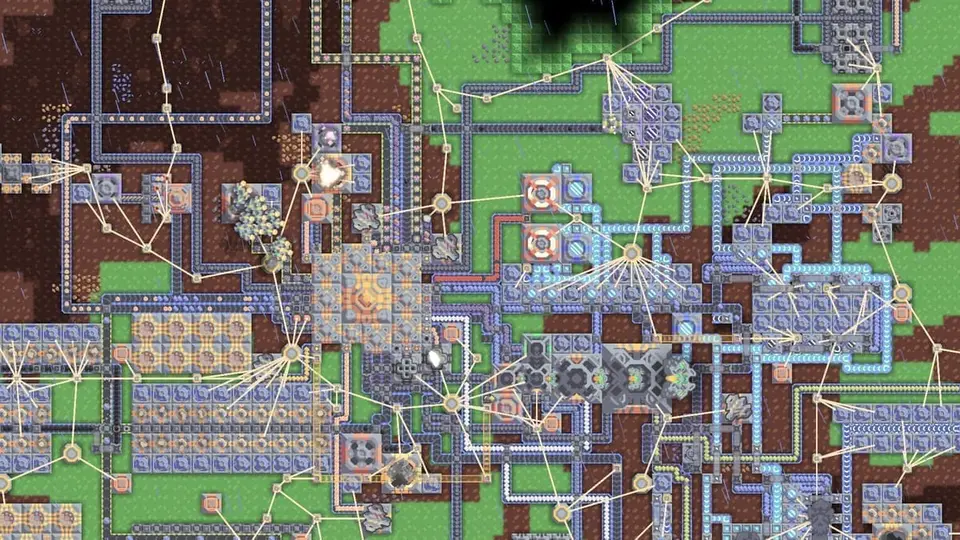
Mindustry is best summed up in one line: Open-source tower defense and factory game with conveyor logistics and turrets. It comes from developer Anuken. The key word is "factory." Turrets in Mindustry are not placed and forgotten. They have to be fed.
The core loop starts with drills on copper and lead ore. Conveyors carry the output to your core and to your turrets. A Duo will fire copper, and it hits harder on graphite, which means building a Graphite Press and keeping coal moving to it. Power-hungry turrets such as the Lancer add generators and power nodes to the plan. Every defensive upgrade turns into a production problem first.
Enemy waves arrive on a timer and push toward your core along their routes. You build the killbox where the path narrows, then spend most of your attention on the network behind it. Sorters, routers, and overflow gates decide whether the front line gets ammunition or whether a belt quietly backs up. When a wave breaks through, the cause is often three screens away from the turret that failed.
You do control a small builder unit that mines, constructs, and can shoot, but it does not carry the defense. Your influence during an attack runs mostly through what you built beforehand. Hold the line by having the right materials arrive at the right place.
Mindustry fits you if solving a support problem feels as rewarding as placing a turret. It suits players who like spotting an idle production chain and redesigning it until throughput stops being the weak point.
It does not fit you if conveyors are a chore you put up with to reach the shooting. If rerouting a belt mid-wave sounds like an interruption rather than the game, the factory layer will wear on you. Mindustry gives logistics-minded players a lot of depth, and it gives players who want to fight very little to do with their hands.
The Riftbreaker puts you on the front line
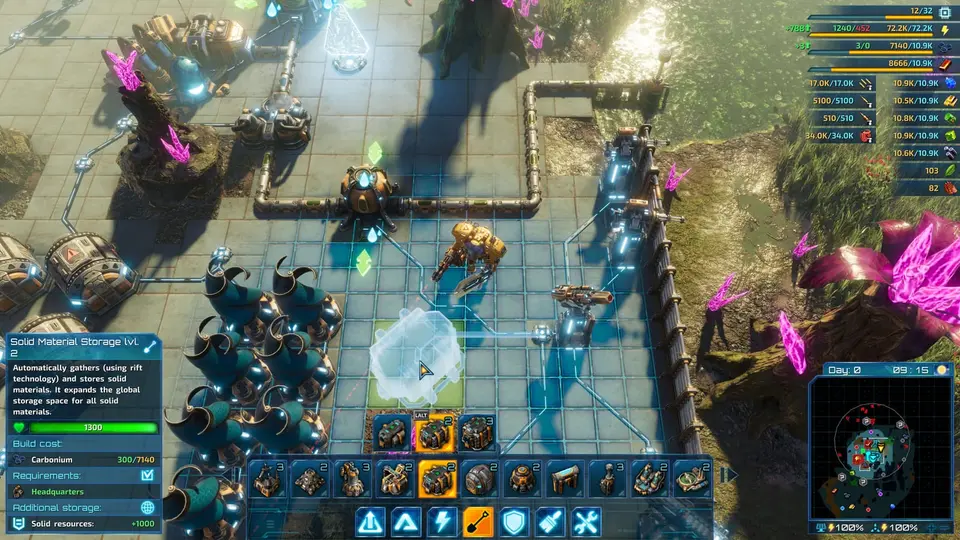
The Riftbreaker is an Action-RPG base builder where you defend your base from alien waves on a hostile planet. It comes from EXOR Studios. Here the base and the fighter belong to one loop. You pilot a combat mech, Mr. Riggs, who builds the base, explores the planet, and fights its creatures in person.
The base still asks for real preparation. You gather resources such as carbonium and ironium. You build an energy grid from sources like wind turbines and solar panels. Then you ring the base with walls and towers before the alien waves arrive. Weapons and gear for the mech come through research and crafting, so preparing for an attack covers both the perimeter and your own loadout.
The real difference shows when an attack lands. You are not waiting at the core for a report. You can run to the wall that is buckling, clear the pack hitting it, and patch the gap while towers handle the other sides. Base preparation sets how much trouble you are in, and your own play decides whether that trouble becomes a loss.
That combination creates pressure Mindustry does not have. Mr. Riggs is one mech, and the planet keeps pulling you away from home toward new resource deposits and objectives. Your base has to stand on its own while you are elsewhere, so you are always judging whether your defenses can hold without you.
The Riftbreaker fits you if you want building and fighting to share the experience, and if action-RPG base building sounds better than base building alone. It suits players who enjoy stepping into the gap personally.
It does not fit you if you want a defense you can plan perfectly and then trust. Your reflexes and positioning matter, which suits some players and frustrates others. If you would rather the colony hold without a hero on the field, the list of games like They Are Billions covers that siege-focused, hands-off side of the genre.
Bottlenecks and rebuilding after a loss
Both games make resources part of the defense, but the bottleneck sits in a different place. In Mindustry, the problem is usually flow: ore exists, yet the belt is too slow, the press is starved, or a router sends ammunition to the wrong place. In The Riftbreaker, the problem is more often reach: you need more of a resource, more power, or a safer route to a deposit, and getting it means going out and building there.
In either game, adding another turret rarely fixes a breach. A new Mindustry turret on a starved belt just splits the shortage. A new tower in The Riftbreaker without the grid to run it adds a target, not a defense. Get the support right before adding firepower.
Recovery comes in two parts, and each game weights them differently:
- Restoring support. In Mindustry, this is the bigger job. Destroyed blocks leave outlines that can be rebuilt, but a rebuilt turret is useless until the conveyors and production feeding it are running again. You end up checking the supply chain from the drill forward.
- Re-securing the position. In The Riftbreaker, this is the bigger job. You go back in person, clear what is still attacking, repair or replace walls and towers, and make sure the energy and resources behind them still reach the damaged side.
Neither kind of recovery is lighter; they ask for different patience. Mindustry recovery feels like debugging: careful, methodical, and satisfying if you like finding the one broken link. Riftbreaker recovery feels like a field operation: physical, immediate, and satisfying if you like cleaning up a fight you just survived. Losses happen in both, so you will play longer in the game whose cleanup you do not mind doing.
How to choose between them
Fortify by how you like to play. Go through these three checks in order and stop when one gives a clear answer.
- Pick your preferred preparation task. If designing production lines and routing resources to turrets sounds like the fun part, choose Mindustry. If walls, towers, and a weapon loadout sound better than belt layouts, The Riftbreaker is your lead candidate.
- Decide how much fighting you want. If you want your own skill to save a failing defense, choose The Riftbreaker, because Mr. Riggs puts you in the fight. If you would rather prove the defense works without you, choose Mindustry, where your builder unit supports the base instead of carrying it.
- Consider the recovery work you would repeat. If tracing a breach back to a starved conveyor sounds tolerable or even enjoyable, Mindustry will keep you engaged. If you would rather rush to the damaged side, clear it, and rebuild on the spot, The Riftbreaker's recovery loop suits you better.
If both games still appeal after all three checks, the tie-breaker is the task you most want to repeat once building your first base stops being new. Choose your frontline. Pick Mindustry when supply networks are the work you want, and The Riftbreaker when direct combat should stand alongside your base. If neither loop fits, browse more base defense games for different ways to defend what you build.