Emberward vs Isle of Arrows: Which Tile-Based Tower Defense Game Should You Play First?
Compare Emberward and Isle of Arrows by maze building, tile RNG, tower control, progression, difficulty, and platforms to find the better tower defense game for you.
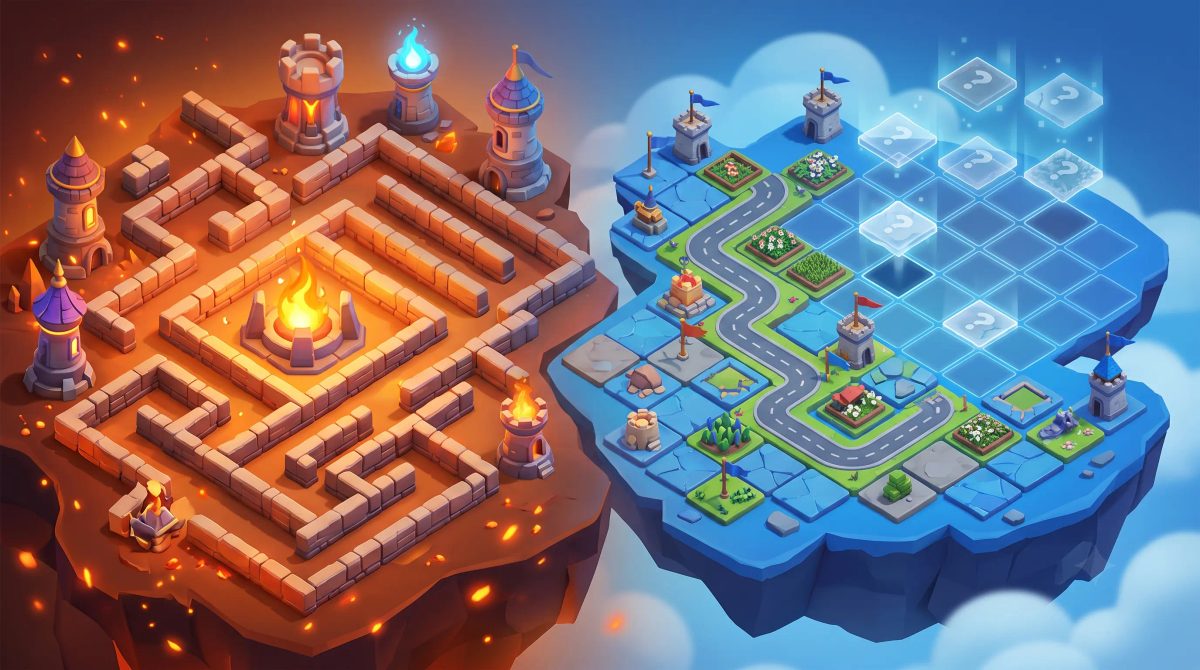
Emberward and Isle of Arrows both make you build the battlefield as you defend it, but they give you very different kinds of control.
Emberward hands you tetromino-shaped wall blocks and asks you to design a maze that makes your towers stronger. Isle of Arrows gives you one randomly drawn tile at a time and asks you to keep an improvised island alive.
The short version: play Emberward first if you want to create the route. Play Isle of Arrows first if you want to solve the route you are given.
The short answer
Emberward is the better first choice for most traditional tower defense players. You have more control over pathing, tower selection, upgrades, and long-term progression. Randomness changes the tools available during a run, but your defense still feels like something you deliberately designed.
Isle of Arrows is the better choice for players who want a compact board-game puzzle. Its rules are easier to read, but its decisions can be harsher. You must place randomly drawn roads, towers, flags, gardens, and support buildings without knowing exactly what the island will need later.
If bad tile draws usually annoy you, start with Emberward. If adapting to an awkward draw is the fun part, start with Isle of Arrows.
Emberward vs Isle of Arrows at a glance
| Category | Emberward | Isle of Arrows |
|---|---|---|
| Core idea | Build mazes with tetromino wall-block cards, then place towers around them | Place randomly drawn tiles to expand an island and its defense |
| Your control over the path | High: blocks let you deliberately redirect enemies | Limited: road tiles arrive in a random order |
| Tower control | Collect towers during a run, place different tower shapes, and use upgrades and synergies | Towers are part of the tile draw; there is no free tower selection or normal upgrade tree |
| Main strategic question | Does this maze give my towers more useful attack time? | Can I place this tile without damaging my future options? |
| Progression | Experience, talents, unlockable characters, flames, towers, relics, and harder challenges | Campaign progress unlocks more content; guilds, modes, modifiers, and daily runs add variety |
| Best quality | Creative maze building with strong tower interaction | Clean, focused spatial decision-making |
| Main frustration | It is easy to build a long maze that is not actually efficient | A poor sequence of tiles can force expensive skips or awkward compromises |
| Platforms | Windows PC via Steam; currently in Early Access | Windows, macOS, iOS, and Android |
| Best for | Players who want a fuller roguelite tower defense game | Players who want a lean tower defense board-game puzzle |
The biggest difference: building a maze versus growing an island
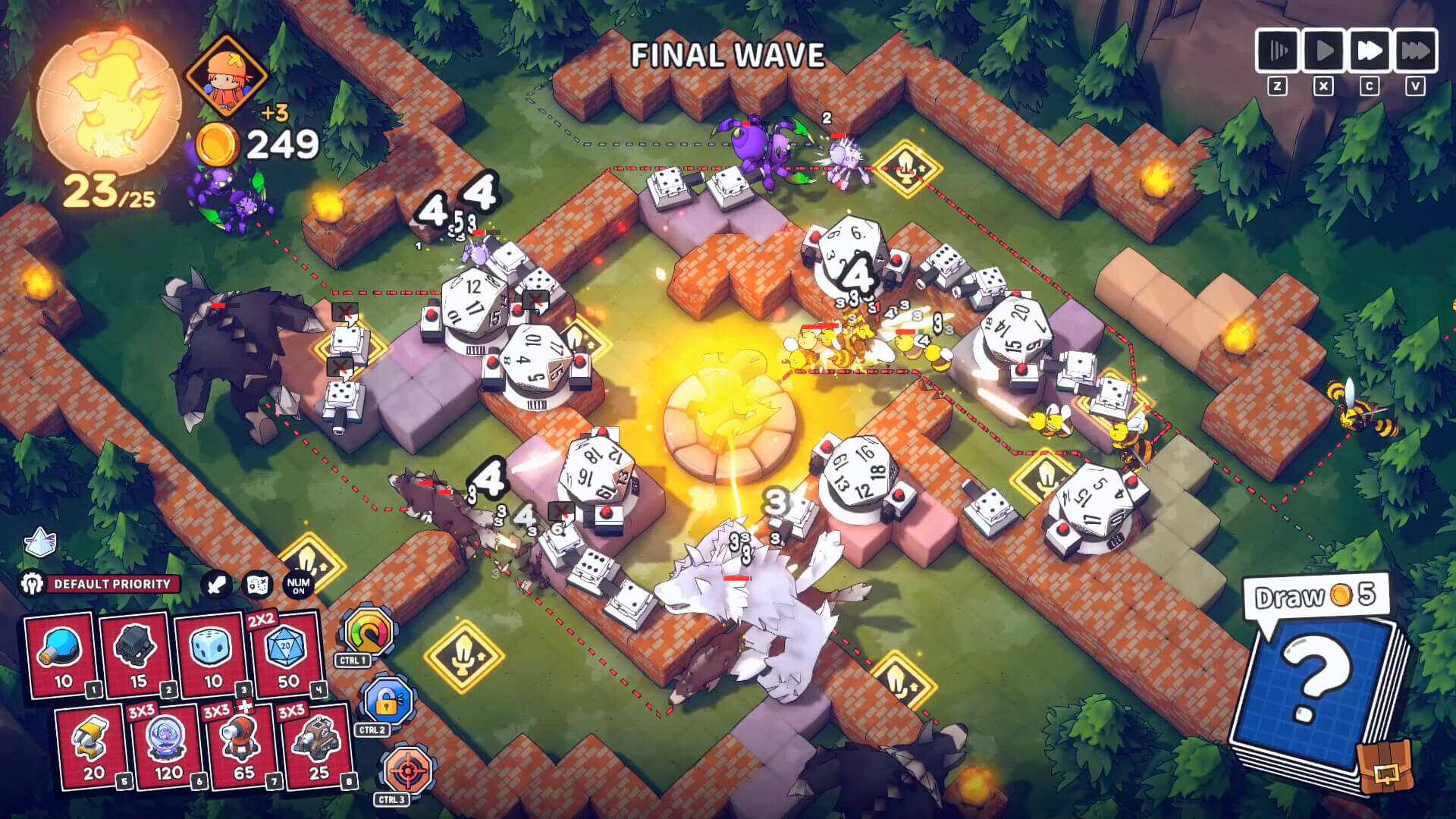
Emberward begins with a familiar tower defense goal: make enemies travel farther while your towers keep attacking. The twist is that you build the maze with limited tetromino-shaped blocks.
Those blocks are not simple road pieces. Their shapes decide where towers can fit, which lanes share coverage, and whether a bend creates useful firing time or merely takes up space. Towers also come in different sizes, so a maze that works for one loadout may leave no good home for another.
This gives Emberward a strong feeling of authorship. Even when the run offers an imperfect set of blocks, towers, and relics, you are usually trying to execute a plan of your own.
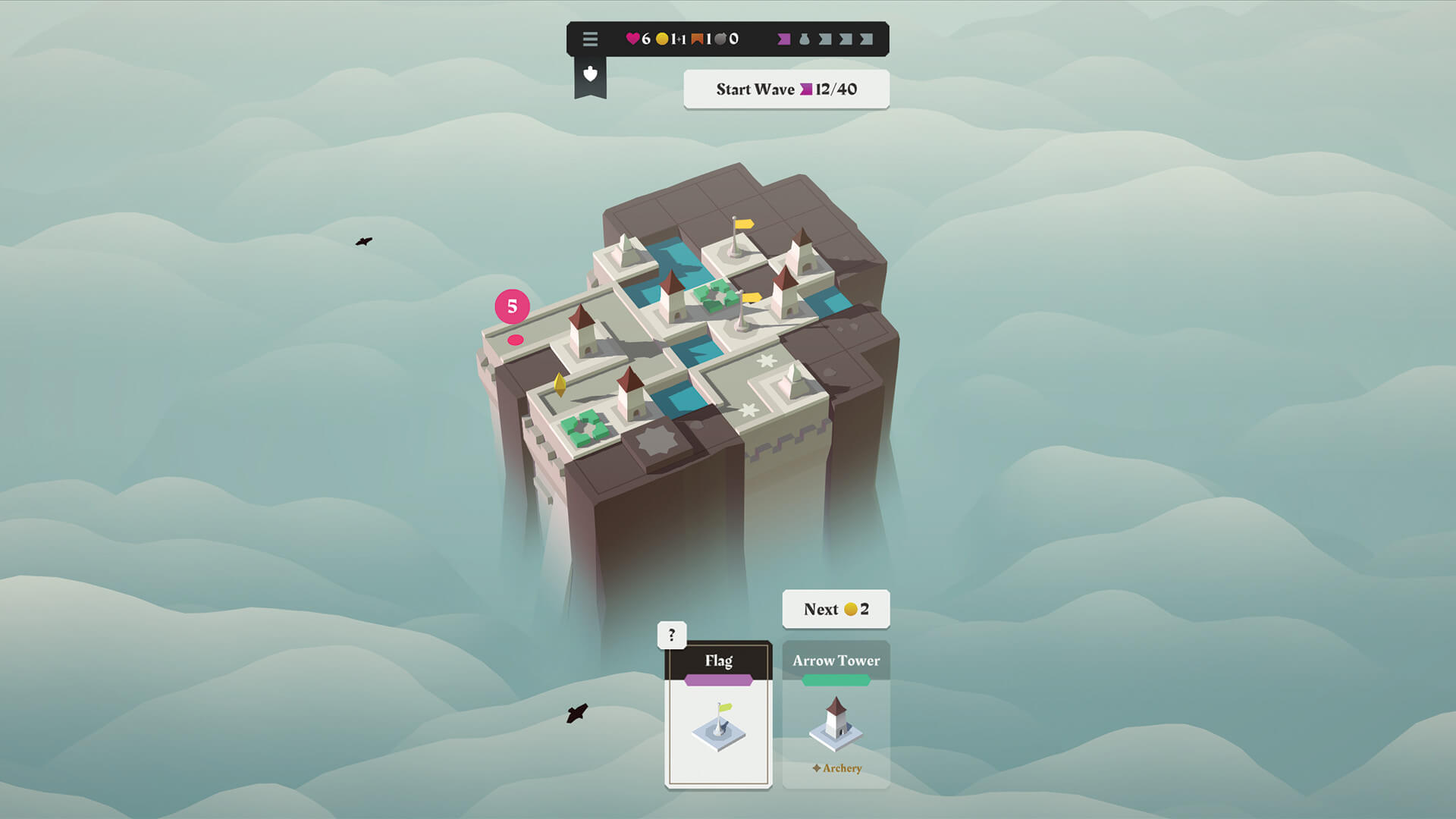
Isle of Arrows feels closer to a board game. Each round gives you a randomly drawn tile. It might contain a road, tower, flag, garden, tavern, or another useful structure. You place it on the growing island, or spend coins to skip it, and then decide when to call the next wave.
You are still shaping the enemy route, but you are not drawing that route freely. The puzzle is to make one imperfect piece work without ruining the board for the pieces that may come next.
That is why Isle of Arrows can look simpler while feeling less forgiving. One harmless placement can block a valuable tower position, turn the road toward a cramped edge, or force you to spend scarce coins on a skip later.
Which game gives you more control over RNG?
Emberward gives you more ways to turn random tools into an intentional defense. You choose where to place each wall block, how to use limited space, which towers deserve premium coverage, and when to strengthen the current setup instead of extending the maze.
The game still has roguelite randomness. Maps, towers, block cards, relics, and rewards vary between runs. The difference is that randomness usually changes the plan you build rather than placing most of the defense for you.
Isle of Arrows makes the draw itself part of the test. The next tile is visible, unwanted tiles can be skipped for coins, and the game guarantees certain categories over time. You are not facing completely uncontrolled chaos, but you do have less freedom to choose exactly what to build.
Good Isle of Arrows play is therefore about preserving options:
- Keep flexible edges where several road shapes could fit.
- Avoid spending every coin before an awkward tile appears.
- Protect useful spaces around existing towers and support buildings.
- Do not expand the road simply because the current piece fits.
- Treat empty space as a resource, not unfinished work.
This system is fair in the way a difficult board game can be fair: you have tools to manage luck, but you cannot demand the perfect piece. Players who want every loss to trace back to a direct tactical choice may still find it frustrating.
Tower strategy is much deeper in Emberward
Emberward is not only a maze puzzle. Its towers have different footprints, ranges, elements, and unusual mechanics. Some benefit from long shared lanes, while others care more about a specific position or block arrangement. Runes, relics, buff cards, characters, and flames add more combinations around them.
This makes tower uptime the best way to judge a maze. A longer path is valuable only when it keeps enemies inside useful attack coverage.
A beautiful maze can still fail if:
- Towers cover only one small part of it.
- New blocks consume the spaces needed by larger towers.
- Damage is spread across too many weak positions.
- Extra distance does not create extra shots.
- Resources go into path length when the current towers need upgrades.
Emberward rewards experimentation because a one-block change can affect several towers at once. Moving a bend may create overlapping coverage, open a larger tower footprint, or let one powerful tower attack the same enemy twice.
Isle of Arrows deliberately offers less direct tower control. Towers arrive as tiles, and the game does not give you a conventional upgrade tree or manual targeting. The strategy comes from placing towers where the evolving road will keep them useful and combining them with nearby structures.
That narrower system is not a weakness. It keeps the focus on spatial planning. However, players who mainly enjoy choosing towers, creating builds, and improving a favorite defense will find much more to work with in Emberward.
Which game has better progression and replayability?
Emberward has the heavier roguelite structure. Runs contain different maps, towers, blocks, relics, and rewards. Experience feeds into talents, while characters and flame types change how a run develops. Additional difficulties and challenge modes give you reasons to return after clearing the main route.
This progression can soften the early learning curve because failure still contributes to future options and power. It also means the game has more systems to learn.
As of July 2026, Emberward is still in Early Access on Steam, although its developer says most planned gameplay systems are already present and development is focused on version 1.0. That makes it the larger and more actively evolving game, but it is not yet the final release.
Isle of Arrows is a finished, more self-contained package. Campaign play unlocks additional elements, while four guilds offer different playstyles. Gauntlet and Daily Defense modes add harder or repeatable challenges after you understand the basic tile rules.
Its replayability comes less from building a complicated character loadout and more from receiving a new spatial problem each time. That is a better fit if you want short, focused runs without a large web of permanent upgrades.
Which one is easier to learn?
Isle of Arrows is easier to understand in the first few minutes. Draw a tile, place it, extend the island, and start the wave. Its minimalist presentation makes the board easy to read.
It is not necessarily easier to win. Limited tower choice and awkward tile sequences can punish a small planning mistake several turns later.
Emberward has more rules to absorb. Tower sizes, block shapes, runes, relics, characters, and upgrade choices create a busier game. However, players familiar with classic maze-building tower defense may find its logic more natural: lengthen the route, build overlapping coverage, and improve the towers doing the most work.
So the answer depends on what “easy” means:
- Choose Isle of Arrows for simpler controls and a cleaner board.
- Choose Emberward for more forgiving strategic control.
Which game makes failure feel fairer?
Emberward usually makes the cause of failure easier to see. If enemies survive, you can inspect the maze and ask whether your best towers had enough coverage, whether your route became too spread out, or whether you invested in the wrong upgrades.
You had more control, so you also carry more responsibility for the result.
Isle of Arrows often hides the decisive mistake a few turns in the past. The final leak may follow an unlucky tile, but the island became fragile when you used your last coin, blocked a flexible edge, or placed a workable road that left no safe continuation.
That delayed consequence is the heart of the game. Some players will find it satisfying to recognize that planning debt. Others will feel that the latest draw mattered more than their earlier skill.
If you enjoy restarting to test a better layout, both games support learning through failure. Emberward gives you more variables to adjust; Isle of Arrows gives you the cleaner puzzle to review.
Play Emberward first if you want...
- Direct control over enemy pathing
- Tetromino maze building with meaningful tower footprints
- More tower types, upgrades, synergies, and build variety
- Persistent talents and character-based progression
- A game closer to classic maze-building tower defense
- Longer-term content and evolving challenge modes
Emberward is the stronger general recommendation. It gives tile randomness an important role without letting it completely define your defense.
The main reason to wait is its Early Access status or Windows-only release. If you want a finished game on Mac or mobile, Isle of Arrows is the practical choice.
Play Isle of Arrows first if you want...
- A compact mix of board game and tower defense
- Random tile placement to drive every decision
- Shorter rules with demanding spatial consequences
- Daily challenges and score-focused replayability
- A finished game available on PC, Mac, iOS, and Android
- A puzzle about adapting rather than executing a perfect build
Isle of Arrows is the more specialized recommendation, but it is excellent at what it does. Every tile asks whether immediate value is worth the space and flexibility it consumes.
Skip it for now if drawing the wrong tower or road sounds more irritating than interesting. The game gives you ways to manage luck, but it never stops being a game about luck under pressure.
Final verdict
The deciding question is simple:
Do you want to design the maze, or rescue the maze from the tiles you draw?
Choose Emberward if you want stronger control, deeper tower building, persistent progression, and more room to turn a random run into your own plan.
Choose Isle of Arrows if you want a cleaner spatial puzzle where restraint, flexible placement, and adapting to imperfect pieces matter more than tower upgrades.
For most tower defense players, Emberward is the better game to try first. It offers the clearer bridge from traditional tower defense into tile-based roguelite design.
For players who already know they love board-game randomness and tight placement puzzles, Isle of Arrows may be the more distinctive choice.
Frequently asked questions
Is Isle of Arrows a deckbuilding game?
No. Isle of Arrows uses randomly drawn placement tiles and separate bonus cards, but it does not have a traditional deckbuilding system. You cannot freely choose which tower to build next.
Does Emberward have permanent progression?
Yes. Battles award experience, and talents make you stronger across adventures. The game also includes unlockable characters, flames, towers, relics, difficulties, and challenge modes.
Which game is better for maze building?
Emberward. Its tetromino blocks give you much more direct control over enemy routes and let you design mazes around tower range, footprints, and overlapping coverage.
Which game is better for short sessions?
Isle of Arrows is the cleaner fit for quick, focused play, especially on mobile. Emberward has more systems and is better suited to players who want to explore builds across a longer roguelite progression.