Bad North vs Thronefall: Which Tactical Defense Game Rewards Better Positioning?
Bad North vs Thronefall compared for players who care about Pikemen chokes, Archer high ground, the King’s night-time aggro, mill-vs-wall spending, and defenses that win through placement instead of tower spam.
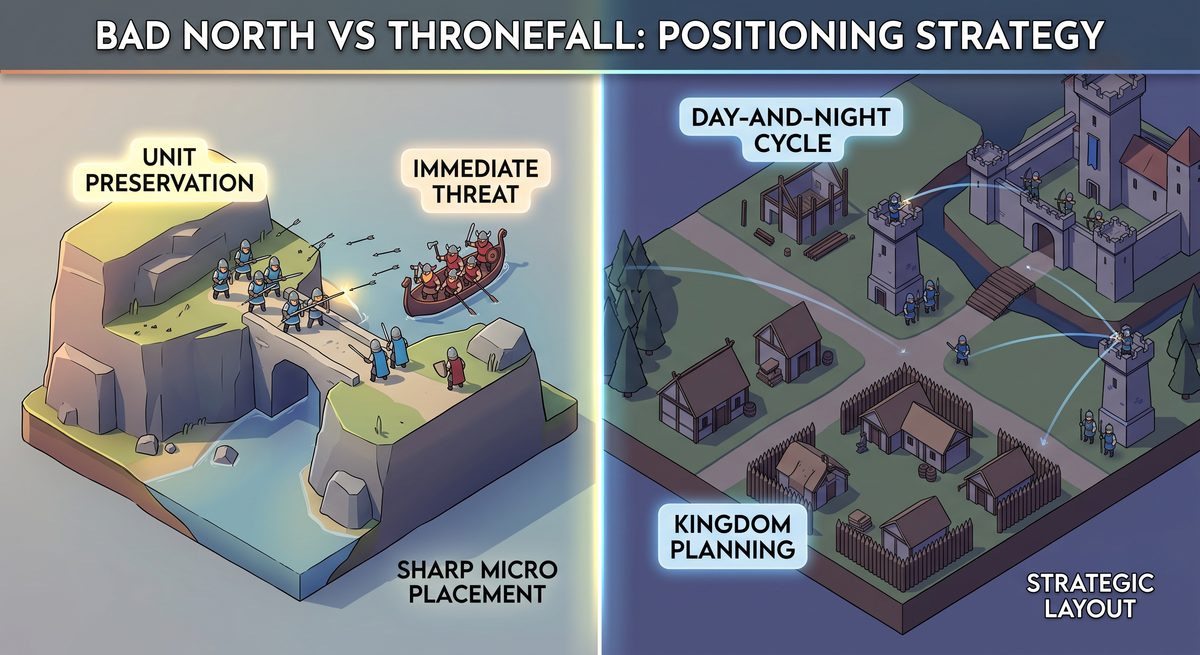
Bad North vs Thronefall is a comparison between two compact defense games where positioning matters more than filling every tile with damage. Both ask you to survive pressure. They test that judgment at different scales: island micro versus kingdom layout.
Bad North is for players who want to place Pikemen, Infantry, and Archers while Viking longboats pick their beaches. Thronefall is for players who want daytime gold spent on mills, walls, and towers, then a King who can peel a leaking lane at night. This piece prioritizes choke control, retreat timing, economy risk, and the cost of losing one key position.
The short answer
Bad North rewards sharper moment-to-moment unit placement. Thronefall rewards better defensive planning over the full day-and-night cycle.
Choose Bad North if you want positioning to feel like a live tactical emergency: which squad holds the slope, which house is about to burn, and when preserving the unit matters more than finishing the clash. Choose Thronefall if you want positioning to emerge from gold, choke construction, and whether the King can still save a mill after the first wall breaks.
Bad North: unit placement under landing pressure
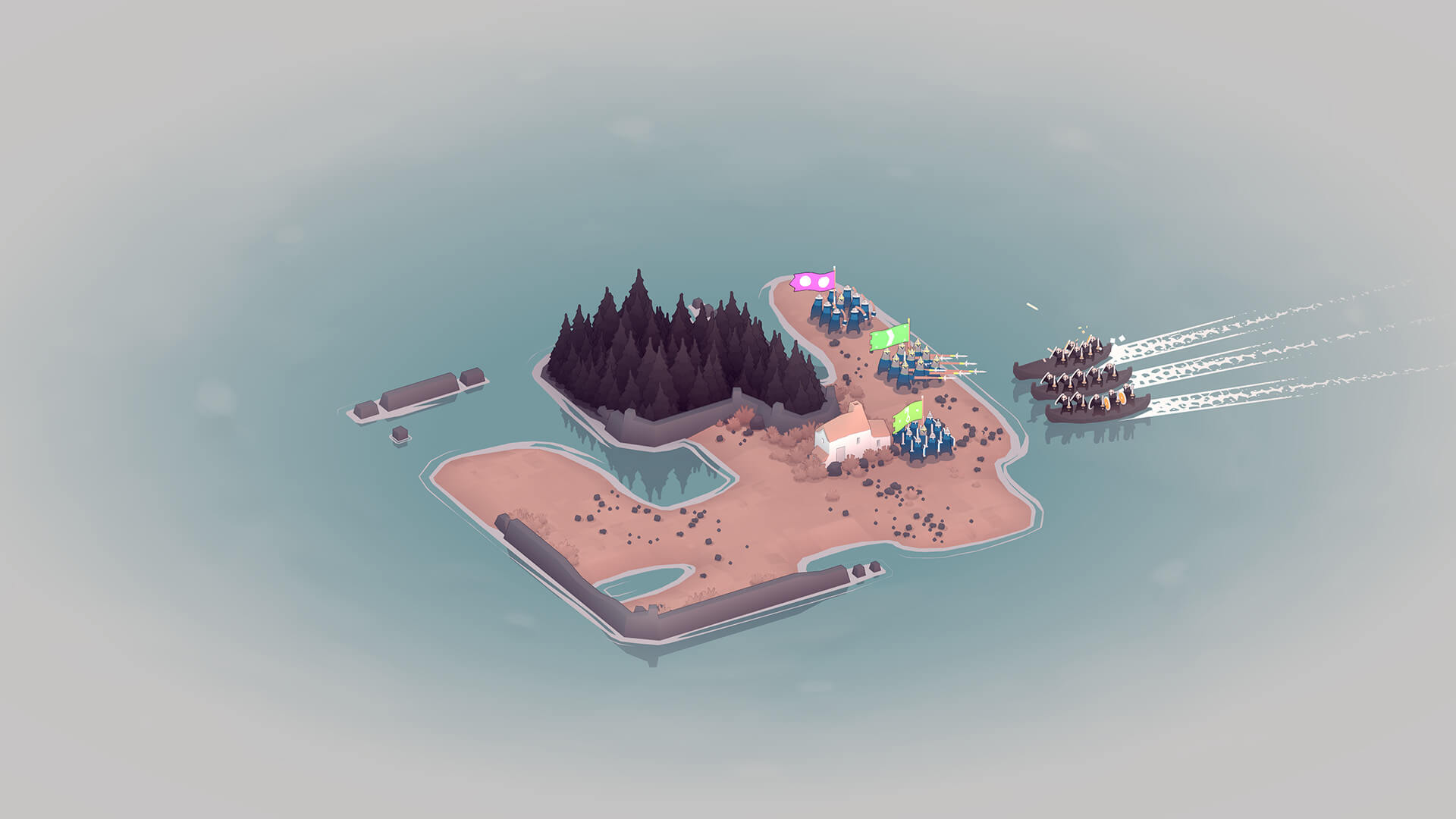
Bad North is compact island tactics. You command a few squads in real time while longboats circle for a beach. Every placement is a relationship with stairs, slopes, houses, and the next hull you have not dealt with yet.
A squad of Pikemen locking a narrow beach slope is brutal from the front. They cannot fight while moving, and they are helpless if a second wave lands behind them while your Archers are still on the wrong ridge. That is the central lesson. You cannot score a defensive line by frontal damage alone. You have to account for a second landing, a downhill pike hold, and whether Infantry shields are actually covering the people who cannot block arrows.
The unit mix makes that concrete:
- Pikemen hold chokes and downhill approaches. Commit them too far onto flat ground and they stop being a wall.
- Infantry are the mobile shield line. Put them in front of Pikes when Huscarls start throwing axes, or use them to escort Archers off a collapsing house tile.
- Archers want high ground before the boats beach. They thin unshielded raiders at sea; they fold if a melee landing reaches them first.
Unit preservation matters more than a damage spreadsheet because lost commanders stay lost. A hold that wins one clash but traps Pikes with no stairs left is worse than a less aggressive setup that keeps a reserve. The common mistake is staring at the first longboat. The island is asking where the second one will land.
What positioning feels like in Bad North
- Immediate and local: You are solving the landing in front of you while another boat is still choosing a beach.
- Highly dependent on escape routes: Infantry need a path off the slope before Pikes get wrapped.
- Punishing of overcommitment: A forward Archer tile becomes a trap the moment melee reaches it.
- Built around readable terrain: Houses, stairs, and high ground make the relationships obvious. Acting in time is the hard part.
Retreating early can save a run. The information is demanding: you have to pull before the second landing closes the stairs, not after the squad is already surrounded.
Where Bad North may not click
Skip it if you want to spend most of your time refining a stable tower layout. The defense is exposed to sudden approach changes, and the pressure is keeping squads alive island by island. Players who prefer visible defensive scaling and long-term construction will find the tactical loop too short-form.
Thronefall: the King, the mill, and the night
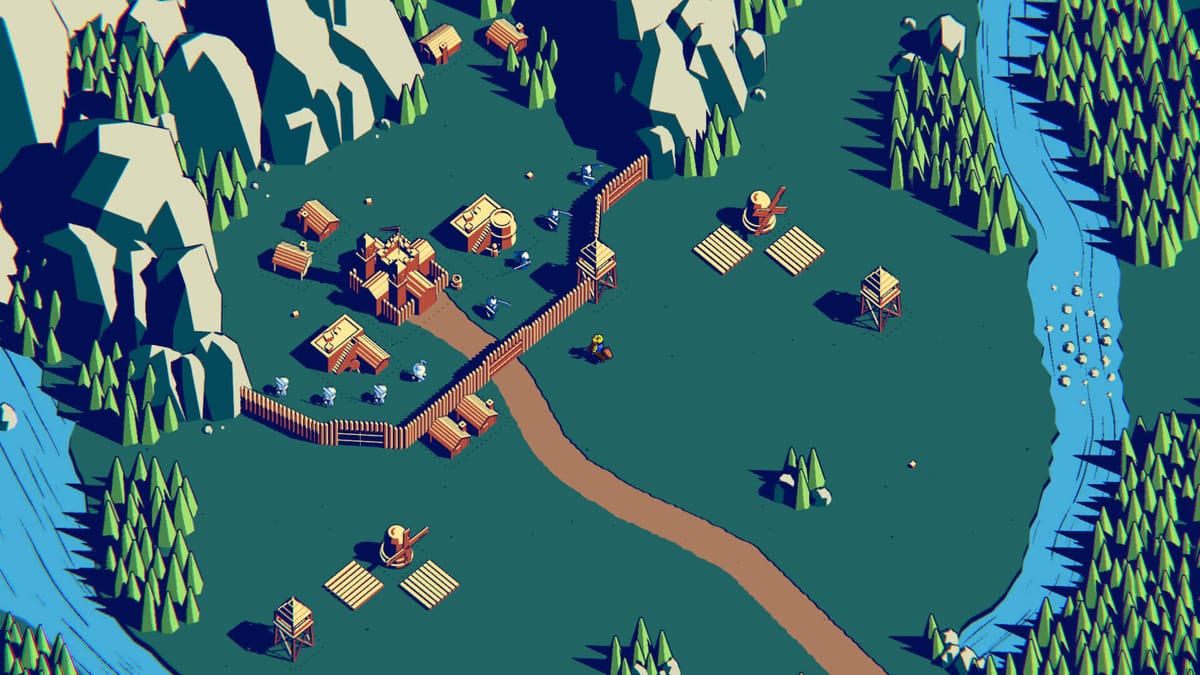
Thronefall starts the other way around. Day is construction. Night is the test. You ride the King between build sites, then fight with him when the wave arrives.
The key question is not where to plant the strongest tower. It is how to spend gold so the Castle Center still stands after a bad night. Mills, houses, and mines pay for later upgrades, but an exposed mill that dies produces nothing until dawn. Walls and towers buy tighter choke control. Barracks troops can be redirected when the next wave comes from a new spawn. Those are different bets, not interchangeable “more defense.”
The King is the in-wave tool Bad North does not have. He does not rebuild structures mid-fight. He kites, draws aggro, and uses his weapon’s active ability to peel a lane off a mill or a cracked wall. A greedy mill line can work if you are willing to ride that lane yourself. It fails if you spent the day upgrading the prettiest tower and left the King too far from the leak.
This is where Thronefall rewards a different min-maxer. The strongest-looking setup may have excellent firing coverage and still collapse because one mill, one wall gap, or one ignored spawn is doing too much of the work. A more modest layout can be better when it keeps a fallback choke, a wall that still funnels, and enough King attention to stop a single breach from reaching the Castle Center.
The central Thronefall mistake
Upgrading the most impressive tower because the damage number is easy to see. A tower that dominates one approach does not automatically protect the mills behind it. Spending gold on a wall that closes a second spawn, or on economy you can actually defend, often beats pushing one already-effective location further.
The pressure is distributed across planning decisions:
- Did you bank gold on mills you cannot cover tonight?
- Which spawn hits first, and is the King there?
- What happens if the strongest tower is no longer the front?
- Can barracks troops rotate, or is the whole plan frozen in place?
- Are you buying damage, coverage, or the ability to recover at dawn?
What positioning feels like in Thronefall
- Planned before the wave: The expensive decisions happen in daylight.
- Economy-driven: Gold forces mill income against walls, towers, and barracks.
- Hero-supported, not hero-replaced: The King patches a plan. He does not substitute for one.
- More recoverable by design: Destroyed buildings come back; a dead Bad North commander does not.
- Less frantic than island micro: You still ride during the night, but the daytime layout carries more of the result.
Where Thronefall may not click
It can feel too deliberate if your favorite part of defense is snapping Pikes onto a new stairway while boats land. Some of the best spends are insurance: a cheap wall, a covered mill, a King upgrade that only looks dramatic when a lane leaks. Players who want every purchase to raise a damage number will underrate those choices.
Readability, retreat, and tunnel vision
Both games keep the battlefield small enough to read. They punish different kinds of staring.
Bad North’s islands make threats obvious: you can see the second longboat, the downhill choke, and the house that will burn if Archers stay put. The window is tight. Retreat means pulling Infantry and Archers before Pikes are wrapped, even if the first beach still looks winnable.
Thronefall’s readability supports construction. You can see mill coverage, wall gaps, and which spawn the King cannot reach in time. Retreat is a budget decision as much as a movement: stop feeding the strongest tower, wall the neglected angle, or ride away from a doomed mill so the Castle Center does not eat the leftover wave.
That is the useful split for a placement min-maxer. Bad North tests whether you can read threat direction. Thronefall tests whether you can read defensive dependency. One asks where the next boat lands. The other asks which building is doing too much work.
Which one is closer to a tactical tower defense game?
Neither is conventional lane TD.
Bad North is the narrower tower defense fit. Its identity is troop command and island defense, not a tower grid. It belongs here because choke control, reinforcement timing, and retreat are the whole loop.
Thronefall is the closer hybrid: city building by day, wave defense by night, with walls and towers as actual structures. It is less about filling pads and more about preparing a stronghold the King can still save.
So the better tactical tower defense substitute depends on structure. Bad North if you want compact tactical defense without tower spam. Thronefall if you want placement tied to economy, construction, and base survival.
Final verdict
If you want every move to account for flanking, high ground, and whether that Pikemen squad can still leave the beach, choose Bad North. If you want to plan a kingdom around mill income, choke walls, and a King who can peel a leak, choose Thronefall.
Both fit players who have outgrown conventional lane maps. The better game is the one that matches the mistake you actually want to solve: reacting too slowly to a second landing, or building a defense that collapses when its best tower, or its most exposed mill, fails.