What Makes a Tower Defense Game Feel Readable?
A design explainer on tower defense readability: clear lanes, useful enemy signals, clean maps, and why the best games make failure easy to understand.
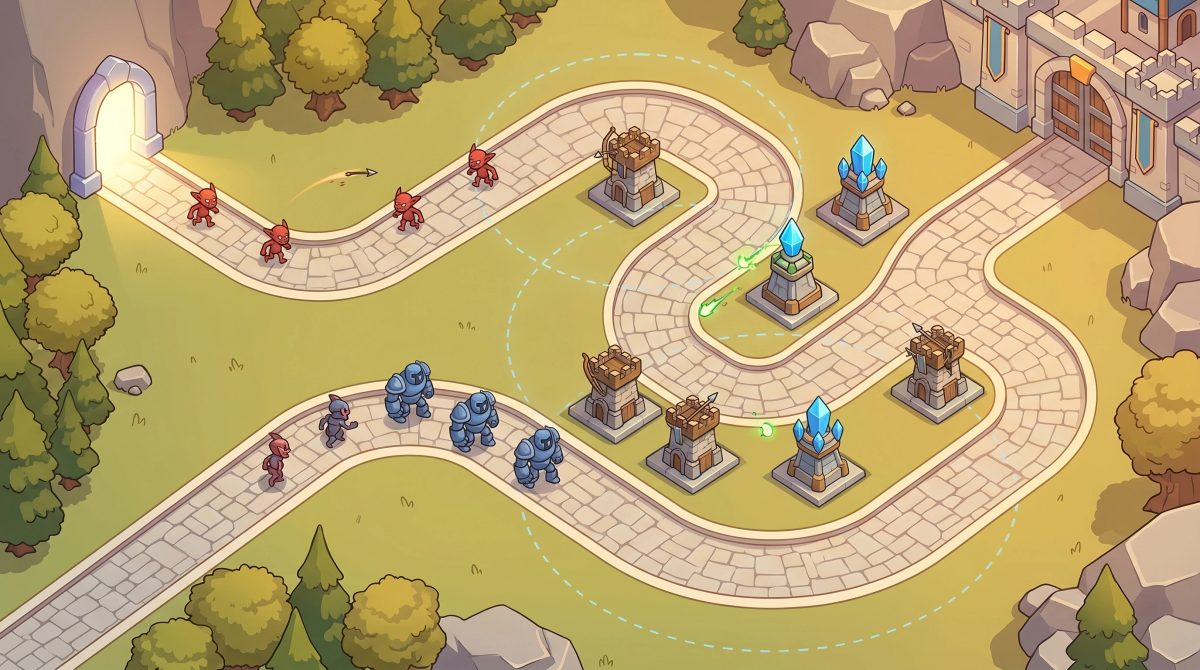
A readable tower defense game does not need to be easy. It needs to let you understand the defensive problem before the wave breaks through.
That is the difference between a clean loss and a frustrating one. In a readable tower defense game, you can usually tell what failed: the left lane had no slow, the air path was undercovered, the chokepoint lacked splash damage, or the final bend had no emergency tower. The game may punish you, but it teaches you.
In an unreadable one, the same failure feels like noise. Enemies blur together, effects hide the route, towers do not communicate their role, and the camera points everywhere except the place that matters.
Tower defense readability is the design work that makes lanes, chokepoints, tower placement, trap timing, enemy priority, and wave response understandable under pressure.
Quick answer
A tower defense game feels readable when the player can quickly answer five questions:
- Where are enemies coming from?
- Where are they going?
- Which towers or traps can affect that route?
- Which enemy type matters most right now?
- Why did the defense fail when something leaks?
Good tower defense map design does not remove pressure. It gives pressure a shape. That shape is what lets players make real decisions instead of just reacting to chaos.
Readability is not the same as simplicity
A readable tower defense game can still be hard. It can have deep upgrades, multiple enemy types, branching paths, late-wave pressure, and awkward terrain. The important part is that the player can see the problem.
When a game is readable, failure feels diagnosable. You know the front lane collapsed because your damage was too spread out. You know the fast enemies slipped through because your slow towers were placed too late. You know the air wave beat you because your anti-air coverage was too thin.
That kind of failure is useful. It gives the next run a clear lesson.
When a game is unreadable, failure feels random. You do not know whether the issue was tower choice, placement, enemy resistance, pathing, economy, or camera angle. You stop thinking like a defender and start cleaning up leaks by instinct.
That shift matters. Once the player cannot read the battlefield, strategy turns into panic.
The lane has to be clear before it can be interesting
Lane readability is the foundation of classic tower defense. Before upgrades, economy, enemy variety, or meta progression matter, the player needs to understand the route.
Plants vs. Zombies is the cleanest example. Its defensive language is almost impossible to misunderstand: enemies move across rows, plants defend those rows, and every placement has an obvious relationship to the lane. That does not make every decision trivial. It makes the board clear enough that the player can focus on timing, spacing, sun economy, and threat priority.
Kingdom Rush is more flexible, but it works for a similar reason. The paths, build spots, enemy movement, and chokepoints are easy to read at a glance. Even when the stage has curves, intersections, or multiple entrances, the map usually tells you where the fight will happen.
That is why strong lane design matters so much. If the player cannot trace the route before the wave starts, everything after that becomes harder to understand.
Unreadable lanes usually come from a few common problems:
- Entrances and exits are not visually distinct.
- Enemy paths overlap without a clear hierarchy.
- Branching routes change pressure faster than the player can process.
- Terrain decoration looks too similar to playable pathing.
- Important movement information is hidden behind effects or camera angle.
Branching paths are not the enemy. Hidden path logic is. A map can split pressure across multiple lanes as long as the player can predict where enemies are going and why.
Build spots should explain the defensive idea
Tower placement is not only about where the player is allowed to build. It is also about what the map is teaching the player.
A fixed build node beside a bend says, “This tower can cover a long stretch.”
A tower slot near a merge says, “This is a chokepoint.”
A placement area near the exit says, “This is emergency coverage, not efficient coverage.”
Good maps communicate those ideas before the player checks exact numbers.
Kingdom Rush benefits from fixed build spots because they reduce placement ambiguity. The player is not fighting pixel-perfect positioning. The real decision is role selection: barracks, archers, mages, artillery, hero movement, or special ability timing. That keeps the focus on defensive planning instead of tiny placement mistakes.
Defense Grid: The Awakening and Defense Grid 2 lean harder into route control and camera clarity. Their maps work because the player can watch the defense as a system. Route pressure, tower range, and enemy flow stay visible enough that mistakes feel easier to analyze.
Free placement can work too, but it carries a heavier readability burden. Mindustry, for example, mixes turrets, conveyors, resource flow, production, and enemy defense. That is a powerful combination, but the player is not only defending a path. They are defending a machine. The map has to make enemy approach, turret coverage, and logistics readable at the same time.
That is much harder than a clean lane map.
Information density is the real difficulty dial
Tower defense difficulty is often described through enemy health, wave count, damage numbers, or tower balance. Those matter, but information density is usually the hidden difficulty dial.
A wave with ten enemies can be harder to read than a wave with fifty if those ten enemies have unclear routes, unclear resistances, or unclear timing. A giant horde can still feel fair if the lane is obvious and the failure point is visible.
Bloons TD 6 is a good example of depth sitting on top of readable movement. The upgrade trees, heroes, tower synergies, and late-game scaling can get deep, but the basic path pressure stays clear. The player may make bad strategic decisions, but the map is not hiding the core question: can this defense handle what is moving through the track?
GemCraft: Frostborn Wrath pushes in another direction. Its depth comes from gem combining, endurance pressure, long-term scaling, and efficient power growth. That can be extremely satisfying, but it raises the reading cost. The more the game asks the player to manage scaling, targeting, and wave endurance, the more important battlefield clarity becomes.
More information does not automatically mean more strategy. Strategy comes from useful information arranged in a way the player can act on.
Enemy readability is about priority
It is not enough for enemies to be visible. The player needs to know which enemies matter.
Readable enemy design answers practical questions quickly:
- Which enemies are fast enough to break through?
- Which enemies need a specific tower type?
- Which enemies punish weak chokepoints?
- Which enemies are distractions?
- Which enemies can be ignored for a few seconds?
A game does not need to explain all of this with text. Shape, speed, animation, color, path behavior, and spawn timing can do a lot of work. The key is consistency.
If a fast enemy looks like every other enemy, the player learns through surprise. If a durable enemy is hidden inside visual clutter, the player cannot prioritize. If special enemies arrive without a clear signal, the wave feels unfair even if the numbers are technically balanced.
This is where visual effects can quietly hurt tower defense readability. Explosions, beams, status effects, crit numbers, and impact flashes are satisfying, but they should not cover the information the player needs most. In a defense game, spectacle has to serve the line.
If the effects make it harder to see the breach, they are not harmless decoration.
Trap-heavy games need cause-and-effect clarity
Trap-heavy defense has a different readability problem. The player is not only asking whether a tower has enough damage. They are asking whether a sequence worked.
Did the spike trap trigger too early? Did the launcher miss the group? Did enemies reach the kill zone before they were slowed? Did the corridor fail because the trap combo was mistimed?
Dungeon Warfare and Dungeon Warfare 2 are built around this kind of dungeon control. Their defensive identity comes from forced movement, trap timing, crowd manipulation, and punishing enemies at the right point in the route. Readability depends on cause and effect. If the player can see why a trap combo worked, they can improve it. If enemies vanish into chaos, the design loses its tactical edge.
Orcs Must Die! 3 has a similar challenge, but with more action pressure. It is third-person trap-and-tower defense, so the player is both architect and active defender. That makes readability harder. The game has to keep the trap logic visible while also giving the player reasons to fight directly.
That tradeoff can be fun. It just changes the readability target. In an action-trap defense game, the player must be able to read both the corridor and their own role inside it.
Hybrid action-defense needs camera discipline
Hybrid tower defense games often struggle because they split attention. The player is aiming, moving, building, checking lanes, spending resources, and reacting to wave pressure at the same time.
Sanctum 2, X-Morph: Defense, Dungeon Defenders, and Dungeon Defenders 2 all sit in this action-defense space. The appeal is clear: you are not only placing defenses, you are helping hold the line yourself. The cost is that the whole-map picture becomes harder to maintain.
That creates one big design question:
How does the player know where they are needed?
A readable hybrid gives strong lane warnings, clear map flow, and enough downtime to make placement decisions before the fight becomes messy. An unreadable hybrid makes every breach feel like it happened off-screen.
That difference is huge. In classic tower defense, a leak usually feels like a planning failure. In a messy action-defense game, a leak can feel like the camera betrayed you.
Base defense is about perimeter pressure
Base defense has a different defensive language from lane-heavy tower defense. The player is not always protecting one road to one exit. They may be managing a perimeter, an economy, and a collapse risk.
They Are Billions, Age of Darkness: Final Stand, Diplomacy Is Not an Option, and Thronefall all ask players to think about holding ground. The important question is not always “Which lane is leaking?” Sometimes it is “Which side of the base is becoming unstable?”
That makes readability more strategic and less positional. The player needs to understand where pressure is forming, where reinforcements are too slow, and which defensive layer will fail first.
In a base-heavy game, the map must make the perimeter readable. If every edge of the base feels equally threatened all the time, the player cannot make meaningful defensive choices.
Thronefall is especially useful as a contrast because its minimalist style lowers the reading cost. The player can focus on day-night pacing, building choices, and wave response without fighting heavy visual noise. Minimalism is not automatically better, but in defense design it can protect decision clarity.
Puzzle-defense needs consequence clarity
Some tower defense games are readable because they limit the board. Others are readable because they make every placement consequence obvious.
Isle of Arrows is a puzzle tower defense built around card-based tile placement and tight runs. Its readability challenge is not only enemy movement. It is spatial consequence. A tile is not just a defense tool. It changes what the future map can become.
That means the player has to read the current wave and the future board at the same time.
Rogue Tower has procedural paths and meta progression, which creates another readability challenge. Procedural layouts can keep runs fresh, but they can also make route priority harder to judge. The game needs to show which path is becoming the real problem and which tower investments will remain useful as the map grows.
Creeper World 4 moves even further away from traditional lane reading. Its enemy pressure is fluid, not a clean line of units. The defensive picture is about containment, front lines, and network stability. Readability means seeing the shape of the threat as it spreads.
The player is not asking, “Which enemy got through?” The question is, “Where is the front failing?”
That is still tower defense readability. It is just not lane readability.
The best tower defense games make failure diagnosable
The best tower defense games do not prevent failure. They make failure readable.
Plants vs. Zombies makes failure diagnosable through lanes. If a row collapses, you know where the problem was.
Kingdom Rush makes failure diagnosable through chokepoints, build roles, and enemy movement. If enemies push through, the map usually gives you enough information to ask whether you lacked blocking, splash damage, single-target damage, or timely hero use.
Defense Grid: The Awakening makes failure diagnosable through route visibility and camera control. You can watch the defensive system work, which makes inefficiencies easier to spot.
Bloons TD 6 makes failure diagnosable by keeping movement clear while tower depth grows around it. The upgrade system is deep, but the path pressure remains legible.
Dungeon Warfare 2 makes failure diagnosable when trap timing and corridor control are visible. A bad trap layout should teach you how to rebuild the kill zone.
These games are not readable for the same reason. That is the point. Tower defense readability is not one trick. It is a set of promises the game makes to the player: you will see the threat, you will understand your tools, and when you fail, the battlefield will tell you why.
Where unreadable tower defense goes wrong
Unreadable tower defense games usually fail in predictable ways.
They hide pathing. Enemies enter from places that are not visually emphasized, or they use routes that do not match what the map appears to show.
They overload the screen. Too many effects, enemy types, alerts, and UI elements can make the wave harder to understand than it needs to be.
They make tower roles unclear. If a tower’s range, target priority, damage type, or ideal use case is hard to read, placement becomes trial and error instead of strategy.
They punish without warning. Surprise can be exciting once. As a repeated design habit, it breaks trust. Tower defense works best when the player feels tested, not tricked.
They confuse activity with depth. More waves, more stats, more upgrade nodes, and more enemies do not automatically create better strategy. If the player cannot interpret the battlefield, extra complexity becomes fog.
The harsh truth is that some games are described as difficult when they are really just hard to read. A hard game makes you think better. An unreadable game makes you squint harder.
A quick readability test
You can judge tower defense readability by asking a few practical questions:
- Can you trace the enemy route before the wave starts?
- Do build spots suggest chokepoints, coverage zones, or emergency positions?
- Can you tell which tower is doing important work?
- When an enemy leaks, do you understand why?
- Does the camera help you manage the whole defense, or does it fight you?
- Do enemy visuals communicate priority?
- Can you separate economy pressure from placement failure?
- When the screen gets busy, can you still see the line?
If the answer is mostly yes, the game is readable even if it is hard.
If the answer is mostly no, the game may still have interesting systems, but the defensive loop will feel noisy.
Takeaway
Tower defense readability is not a happy accident. It is built through lane structure, camera behavior, placement rules, enemy signaling, wave pacing, and visual restraint.
The best games make this look effortless. Plants vs. Zombies makes lanes feel natural. Kingdom Rush makes map decisions feel obvious without making them shallow. Defense Grid: The Awakening keeps the full defensive picture in view. Bloons TD 6 lets deep upgrades sit on top of readable path pressure.
That is what strong tower defense map design does. It gives players enough clarity to make meaningful mistakes. Then it lets them fix those mistakes with better lane control, stronger chokepoints, smarter tower placement, cleaner trap timing, or faster wave response.
A readable tower defense game does not remove chaos. It gives chaos a shape.