Orcs Must Die 3 vs Dungeon Defenders 2
Orcs Must Die 3 and Dungeon Defenders 2 are both action-tower-defense hybrids, but they reward different skills, handle co-op differently, and suit different kinds of players.
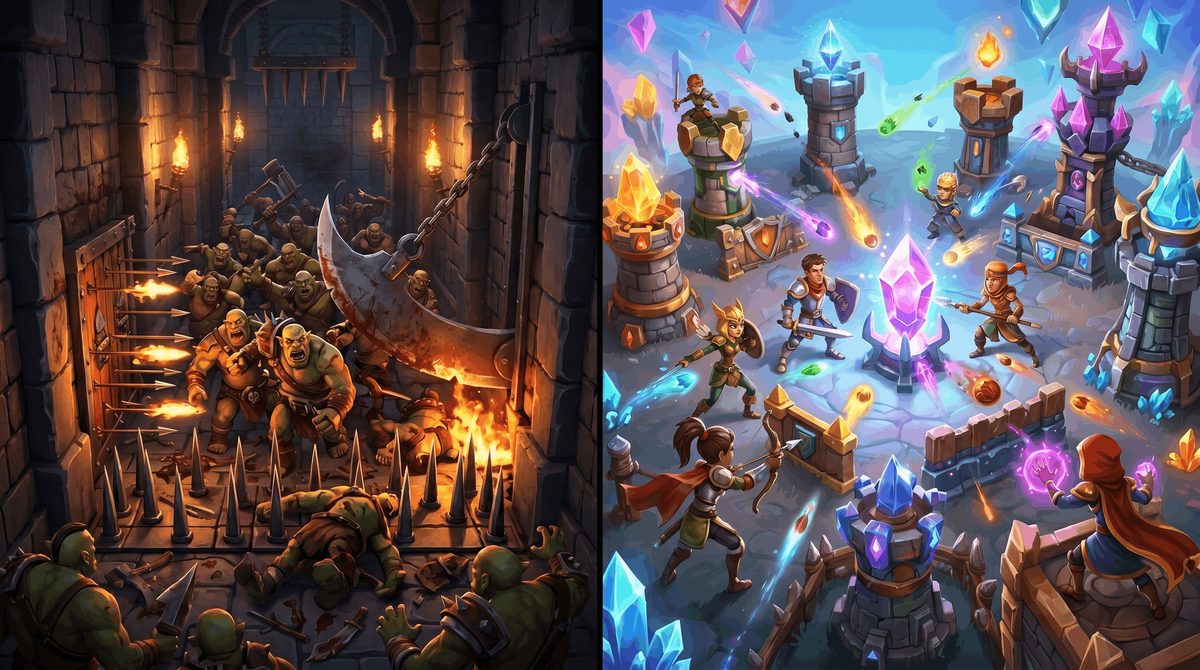
Orcs Must Die! 3 vs Dungeon Defenders 2 is a closer call than it first appears.
This comparison is for players who care about actual defense loops, not just action games with waves. I prioritized lane control, choke quality, trap usage, base pressure, solo readability, and how much each game asks you to win through clean execution versus broader hero-and-tower planning.
The short verdict
If you want one clean recommendation, start here.
- Choose Orcs Must Die! 3 if you mostly play solo, want the sharper moment-to-moment game, and care most about building brutal kill zones around clear lanes.
- Choose Dungeon Defenders 2 if you have a regular co-op group, want more hero and tower experimentation, and like a defense game with a longer runway.
- If your main question is "which feels better to actually play minute to minute," Orcs Must Die! 3 has the edge.
- If your main question is "which gives me more to build around over time," Dungeon Defenders 2 has the edge.
The common mistake is treating them like near-identical substitutes. From the outside, both are action-tower-defense hybrids. In practice, they ask very different things from the player.
Why they feel different
Orcs Must Die! 3 is built around trap choreography in tight kill zones. Its defensive identity is lane-heavy and trap-heavy. The rift gives the whole map a focal point, so your job is usually to read lanes quickly, force enemies through efficient kill spaces, and step in with active combat when a setup starts to leak.
Dungeon Defenders 2 pushes toward a broader, more distributed kind of defense. The crystal is still the core objective, but the defense feels less like "make this one funnel perfect" and more like "cover shared space well enough with the right heroes, towers, and active response." That makes it more hero-driven and more build-oriented.
That distinction matters more than the shared premise. If what you want is a game where trap timing and choke control are the main event, Orcs Must Die! 3 is closer to the mark. If what you want is a hybrid where your roster choices and group composition matter a lot, Dungeon Defenders 2 makes more sense.
Solo play: Orcs Must Die! 3 has the clearer edge
For many players, this is the deciding category.
Orcs Must Die! 3 rewards tighter solo execution because the defensive puzzle is easier to read. You can look at a lane, decide where the kill box belongs, build around the rift, and understand very quickly why a wave held or collapsed. That feedback loop is a big deal. It keeps the game honest. Good trap placement feels earned, and mistakes are usually visible rather than vague.
The better-feeling combat helps too. Orcs Must Die! 3 has a cleaner link between what you build and what you do during the wave. You are not just standing behind towers. You are reinforcing the plan, catching leaks, and turning a good setup into a dominant one.
Dungeon Defenders 2 can still work solo, but solo is not where its strengths come through most clearly. The broader crystal defense and heavier hero-build emphasis make it feel less focused when played alone. It gets tricky when some players read "more heroes, more towers" as automatically better solo value. Sometimes it is. Sometimes it just means more setup load before the defense starts to feel satisfying.
If you want compact decision-making, readable lanes, and a stronger sense of cause and effect, Orcs Must Die! 3 is the better answer.
Co-op: Dungeon Defenders 2 opens up more with a group
This is where the comparison swings.
Dungeon Defenders 2 benefits more from co-op because its defense is broader and more shared. More heroes and more towers matter more when multiple players are actually bringing different tools into the same defense. The maps feel less like a single trap puzzle and more like a collaborative hold-the-line problem. One player can stabilize a weak side, another can lean into active combat, and the whole team can shape how the crystal is defended.
That makes co-op feel more transformative in Dungeon Defenders 2. The game is not just adding another body to the same plan. It is letting the defense become more layered.
Orcs Must Die! 3 does support co-op, and it can be excellent there, but co-op changes less about its core identity. The main question is still whether the trap plan is good enough. Extra players help with cleanup, pressure handling, and mistake recovery, but the heart of the game remains that same tight kill-zone logic.
So if your duo or group wants a precise, lane-focused action-defense game, Orcs Must Die! 3 still works. If your group wants a game that gets broader and more social when more players join, Dungeon Defenders 2 is the stronger co-op pick.
Trap choreography vs hero builds
The reason Orcs Must Die! 3 fits this topic so well is that it understands how satisfying a tight choke can be. The rift-centered structure gives every trap decision a clear purpose. You are not placing defenses because the map technically has space for them. You are placing them to create a sequence: slow here, bunch there, punish hard at the center, then personally clean up what survives.
That sequence is the game.
Dungeon Defenders 2 has a different priority. Its appeal is less about the elegance of one kill corridor and more about the interplay between heroes, towers, and map-wide defense coverage. This rewards tinkering, composition, and broader setup thinking.
Neither approach is automatically better. But they satisfy different cravings.
If you play hybrid defense games because you love watching a perfectly built choke erase a wave, Orcs Must Die! 3 is the right kind of obsession. If you play them because you want more build variety and more room for co-op roles, Dungeon Defenders 2 is the better match.
Base pressure and map readability
The rift in Orcs Must Die! 3 does a lot of work. It gives the map a center of gravity. That makes lane structure easier to read and makes defensive failures easier to diagnose. You usually know where pressure is building and why it matters.
This tends to matter when you are learning a map or trying to improve a weak setup. Strong map readability makes experimentation faster. You can move a trap line, adjust a choke, or commit more active attention to one lane and immediately see the result.
By contrast, Dungeon Defenders 2 feels broader around its crystal defense. That can be a real advantage in co-op, because distributed pressure gives more players meaningful jobs. It can also feel less crisp if you wanted a single, decisive kill zone to optimize.
That is the core tradeoff: Orcs Must Die! 3 gives you more structure; Dungeon Defenders 2 gives you more spread.
Moment-to-moment feel vs long-term runway
If you only care about how good the defense feels during actual waves, Orcs Must Die! 3 wins.
That does not just mean the weapons feel good. It means the entire loop is tighter. Trap results are easier to read. Choke control matters more. Your active intervention matters at exactly the right moments. When a defense works, the payoff is immediate.
Dungeon Defenders 2's strength is different. It has the longer progression tail. More heroes and more towers give it more room to grow into over time, especially if you like building out options and coming back with a group. The main friction is that this broader progression angle matters less if what you wanted was an instantly satisfying trap-action game.
This is where a lot of players misread the comparison. They assume the game with more build breadth must be the better overall choice. Not necessarily. If the first thing you want is defensive clarity and strong wave-to-wave pacing, breadth can matter less than focus.
Small practical factors that actually matter
A few details are not the whole story, but they can break a tie.
Orcs Must Die! 3 lists full controller support. Dungeon Defenders 2 lists partial controller support. If you strongly prefer playing this kind of hybrid defense game on a controller, that matters.
Both support single-player, multiplayer, co-op, and online co-op, so the bigger difference is not mode availability. It is how much those modes change the game. As a rule, solo favors Orcs Must Die! 3 more clearly, while co-op favors Dungeon Defenders 2 more clearly.
Dungeon Defenders 2 is also free-to-play. That lowers the barrier if you mainly want to test the co-op and progression side without committing upfront. But free entry does not solve fit. If you want a tighter, more self-contained trap-defense game, Orcs Must Die! 3 is still the better match.
Which one should you choose?
Choose Orcs Must Die! 3 if
You want the better solo hybrid defense game.
You care most about trap efficiency, kill-box design, and readable lane pressure.
You want the stronger moment-to-moment feel.
You like the idea of defending a clear focal objective, with the rift anchoring the whole map.
You do not need the longer progression tail to stay engaged.
Choose Dungeon Defenders 2 if
You have a regular co-op group and want a game that opens up more with shared defense roles.
You want more heroes, more towers, and more room to experiment over time.
You prefer broader crystal defense over a tighter rift-centered structure.
You are fine with a defense loop that is less about one perfect choke and more about overall map coverage and build planning.
Final answer
If you are asking which is better with no extra qualifiers, Orcs Must Die! 3 is the stronger recommendation. It has the clearer defensive identity, the better moment-to-moment feel, and the better solo experience.
Dungeon Defenders 2 becomes the right answer when your priorities change. If you want the longer progression tail, more hero-and-tower variety, and especially a better co-op fit for a regular group, it has the advantage.
So the cleanest way to frame it is this: Orcs Must Die! 3 is better at tight, satisfying defense. Dungeon Defenders 2 is better at broader, group-friendly build play. Pick the one that matches how you want to defend, not just the one that looks similar in screenshots.